By J. Chen ma OS
1. Introduction
When one comes to think about the beauty of mathematics, typically what comes to mind initially is its certainty, achieved through rigorous proofs and immutable logical rules. Mathematics seems to be a safe haven from the many uncertainties we encounter in the physical world today, yet there are a few yet significant instances where mathematics as a language contradicts itself. For instance, what happens when something as trivial as a simple mathematical definition contradicts itself? What happens when a ‘universal’ mathematical system cannot prove certain statements? Is it possible for any of these paradoxes to coexist? Such questions have arisen from distinguished mathematicians and philosophers who sought to expose such inconsistencies within mathematics. This article will examine two such paradoxes: Bertrand Russell’s Paradox and Kurt Gödel’s Incompleteness Theorem, and will show how each effectively exposes some logical flaws within the field of mathematics.
2. Russell’s Paradox
Around the turn of the twentieth century, mathematicians attempted to create a fundamental logical base for mathematics to ensure the consistency of all mathematical reasoning. One of the primary ways they sought to achieve this was using Set Theory. A classic example of this is the set of all prime numbers, formally defined as:
Membership of a given set meant that an object belonged to that specific well-defined collection. However, due to the broad nature of elementary or naïve Set Theory, Russell probed upon one key assumption which led to a logical flaw. The broad principle of naïve Set Theory was that any well-defined property could create a set which contained all the members satisfying such a set. For instance, if we took the example above, the property ‘ is prime’ defines the set of all prime numbers. This can equally be applied to a property in which nothing satisfies such a property. For instance, the condition ‘ is both odd and even’ defines an empty set. The broader principle is that it does not require the property to be satisfied by any elements. In 1901, English mathematician and philosopher Bertrand Russell discovered the following that logical flaw in allowing naïve Set Theory to continue without implementing restrictions; this can be demonstrated in the example below:
2.1 The Flaw
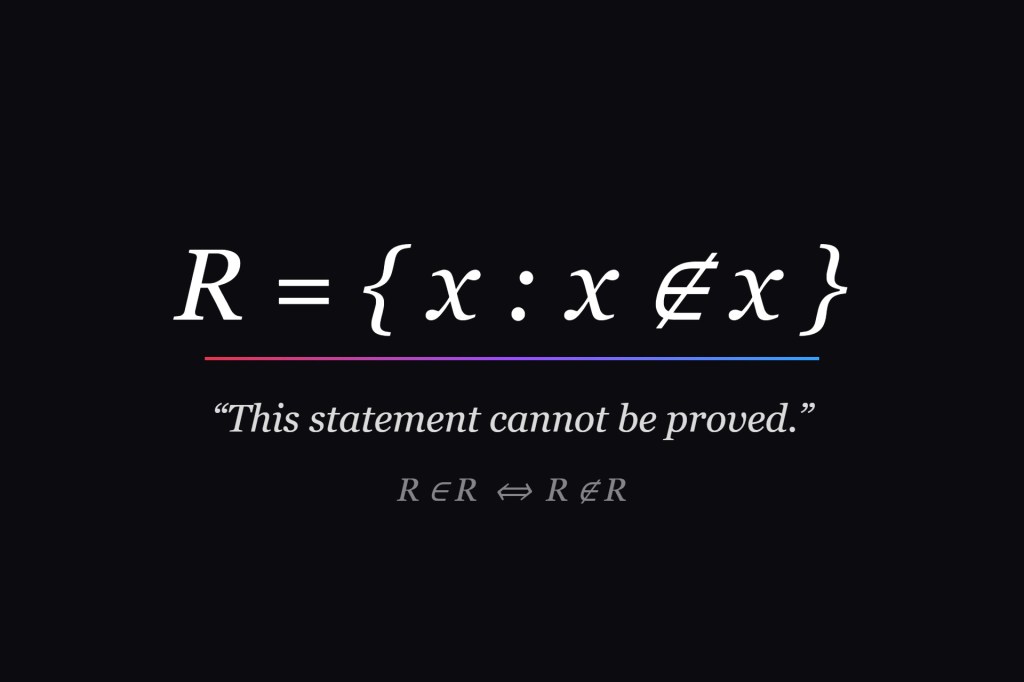
Let denote the set of all the sets which do not contain themselves an element:
This means that is an element of but the set is not a member of itself. Subsequently, Russell asked whether the set belonged to itself. If , the very definition of is that its members do not contain themselves. Therefore, , contradicting the previous assumption. Now suppose that . However, again, the definition of is that it is the set of sets which do not contain themselves as members. Hence, we obtain , which again is a contradiction. As a result, neither possibility is valid with this definition of meaning that
This has larger implications than a simple unintuitive result. The unrestricted assumption itself creates a logical contradiction. Russell used his famous Barber Analogy to explain this concept:
Imagine there is a barber in a village who only shaves those who do not shave themselves. The question Russell proposed was ‘Does the barber shave himself?’. If we take it that he does shave himself, it contradicts our assumption that the barber only shaves those who do not shave themselves. If it is that he does not shave himself, he is a member of the group satisfying the condition for the barber shaving the person, meaning that the barber must shave himself; Hence, we establish a contradiction. Therefore, similar to the set , a barber with such a condition cannot exist.
2.2 Implications
This is significant because it led to a seismic shift in the way formal logic was used to define mathematics. Ultimately, it resulted in the creation of axiomatic set theories such as Zermelo-Frænkel Set Theory which placed explicit restrictions on how sets could be constructed. Russell’s paradox demonstrated the requirement for the precise definition of collections and verification of whether it was logically sound for a set to exist. This remains an important consideration for mathematicians when formulating definitions to ensure that special cases do not result in logical fallacies. However, a general misconceptio nto avoid is that Russell did not claim that mathematics as a whole was illogical; rather, he showed that unrestricted principles of set formation can lead to logical fallacies. Creating such definitions without logical gaps is very relevant to the next paradox we will discuss, where mathematicians attempted to formalise mathematical reasoning through a system based on a set of axioms and rules to form the foundations of mathematics itself.
3. Gödel’s Incompleteness Theorem
In the early 20th century, mathematicians such as David Hilbert tried to formalise all of mathematics through a single consistent system. The goal was to establish a secure foundation using a set of basic axioms and rules of inference to ensure that all truths could be systematically proven. Austrian logician Kurt Gödel showed that the creation of such a system still has fundamental limitations and that even a consistent formal system cannot be fully comprehensive. Before we move onto Gödel’s ‘Statement about Itself’, we must first define and distinguish between two key properties of a formal system: Consistency and Completeness. Consistency means that the system cannot prove both a statement and its negation. Completeness means that for every statement expressible in the system, either the statement or its negation can be proved within the system. Gödel demonstrated that a sufficiently rich formal system can be consistent, yet incomplete.
3.1 A Statement about Itself
Gödel developed a method known as ‘Gödel Numbering’ which assigned unique natural numbers to mathematical symbols, statements and proofs. By doing this, Gödel allowed for arithmetic to represent statements about their provability. Consequently, this allowed for a formal system to indirectly express statements about its own structure. Using this system, Gödel constructed a formal mathematical statement that asserts: ‘This statement cannot be proved within this formal system.’
This was especially ingenious from Gödel as he managed to express a statement which showed something about its provability which is what a formal system is supposed to form the foundation of.
A contradiction arises if one attempts to prove :
- If is provable within the system, then the system has proven a statement that asserts its own unprovability, rendering the system inconsistent.
- If is not provable within the system, then is true in what it asserts, but cannot be proven by the system, rendering the system incomplete.
Assuming the system is consistent, must be unprovable, establishing Gödel’s First Incompleteness Theorem: any consistent formal system capable of expressing basic arithmetic is incomplete.
Gödel’s Second Incompleteness Theorem extends this result by demonstrating that such a system cannot prove its own consistency using its own axioms and rules of inference. Hence, even the most complete and consistent formal systems will always have something which is impossible to prove. Importantly, Gödel did not state that all mathematical truths are impossible to prove, but rather that he is stating that no single formal system can encapsulate all mathematical truths. It is the internal inconsistency which Gödel is examining which is within the confines of specific formal systems.
3.2 Implications
What Gödel demonstrated was the impossibility of unifying mathematics under one consistent and complete formal system. This profoundly affected the foundations of mathematics as it meant any formal system always had its limitations which had to be acknowledged. Furthermore, Gödel’s Incompleteness Theorems also distinguished between mathematical truths and proofs. Truths are when a statement holds up under the arithmetic while proof concerns itself with determining whether a statement can be derived from a set of axioms and rules. Thus, this raises the question of whether truths can be fully captured by proofs, or would there be a limitation to this which would require either stronger methods or assumptions for a truth to be fully captured? With more assumptions, does this defeat the whole purpose of a formal system, or does it need redefining?
4. Conclusion
From the works of Russell and Gödel, we have shown that definitions and formal systems have key logical limitations which seem paradoxical to the notion that mathematics is a language of certainty, raising questions such as: what does this tell us about the relationship between reason and truth? Does something being provable make it true and vice versa? The resolutions of such logical gaps only open more doors to endless questions on its mathematical and philosophical implications, questions which are perhaps impossible to prove true in certain formal systems and certainly impossible to answer in this short article. Perhaps it is mathematics’ characteristic of being so uncertain and the questions it raises rather than the questions it solves which is what makes it a truly beautiful subject.
References
Baldwin, John T., and Olivier Lessmann. “What Is Russell’s Paradox?” Scientific American, 1998, https://www.scientificamerican.com/article/what-is-russells-paradox/.
Raatikainen, Panu. “Gödel’s Incompleteness Theorems.” Stanford Encyclopedia of Philosophy, Stanford University, 2025, https://plato.stanford.edu/entries/goedel-incompleteness/.
“Russell’s Paradox.” Stanford Encyclopedia of Philosophy, Stanford University, 2026, https://plato.stanford.edu/entries/russell-paradox/.
Wolchover, Natalie. “How Gödel’s Proof Works.” Quanta Magazine, 14 July 2020, https://www.quantamagazine.org/how-godels-proof-works-20200714/.




Leave a Reply