By Ruengsawang
A Unique View of Mathematics
Imagine trying to solve a mathematical problem so complicated that you cannot even envision what the answer might look like. Imagine spending hours drawing, sketching curves, covering sheets of paper with diagrams, and following an idea that may not actually lead somewhere for as long as months. For Maryam Mirzakhani, this approach was very familiar. It was how she explored some of the hardest unsolved questions in modern mathematics.
Mirzakhani was born in Iran on 12 May 1977. She did not grow up knowing that she would become one of the world’s most celebrated mathematicians. As a child, she was interested in literature and imagined becoming a writer. Mathematics gradually caught her interest, not simply because she was good at it but because it offered problems that could be explored from countless different angles instead of just having one route to reach the answer. She later compared mathematical discovery to being lost in a jungle, in that you gather whatever knowledge you can, search for a way forward, and hope to find a route through. It is a unique description of a subject that is often presented in school as one with neat, predictable working that leads to answers.
Her approach would eventually take her from a school in Tehran to some of the world’s best universities, and in 2014 she became the first woman ever to receive the Fields Medal (which is one of mathematics’ highest honours). However, the most interesting part of her story is not the award she won, but the way her mind worked: the questions she chose to solve and the extraordinary mathematical methods and viewpoints she helped the world to understand.
From School to Global Success
Mirzakhani’s path into mathematics was not entirely straightforward. She initially struggled with the subject in school, but a change in teachers helped her recognise her potential. By her teenage years, she had become an exceptional problem solver. In 1994, aged 17, she won a gold medal at the International Mathematical Olympiad, becoming one of the first two girls to represent Iran at the competition. The following year, she returned and achieved a perfect score, winning another gold medal.
These competitions tested much more than just memory. Their hardest problems required the mathematicians to recognise patterns, make connections, and formulate proofs. These were precisely the skills that would later help Mirzakhani with her research. After studying mathematics at Sharif University of Technology in Tehran, she moved to the United States to study at Harvard University, where she worked with the mathematician Curtis McMullen. Her doctoral thesis, completed in 2004, answered longstanding questions about the geometry of curved surfaces and brought together ideas from several different areas of mathematics.
She went on to work at Princeton University before joining Stanford University as a professor. At this point, she was no longer solving problems set by somebody else; she was deciding which problems deserved to be asked in the first place. Advanced mathematics is almost a completely different subject from the maths we get taught at school. It is about asking the correct questions and exploring creative paths to solutions.
What Do Mathematicians Actually Study?
Understanding Mirzakhani’s work helps one see how mathematicians solve problems. Mathematicians are interested not only in the shapes of objects but also in their underlying properties. For example, a sphere has no holes, while a doughnut has one. A surface with two holes has a different structure again. These distinctions remain regardless of whether the objects are stretched or bent (as long as they are not torn).
Mirzakhani studied objects known as ‘Riemann surfaces,” which are sophisticated mathematical surfaces that combine geometry with ideas from complex analysis. Some have the general structure of a doughnut, while others have several holes and much more complicated geometry. Rather than studying just one surface, mathematicians can investigate the entire collection of possible surfaces of a particular type.
This brings us to one of the central ideas in Mirzakhani’s research: a ‘moduli space’. The name sounds intimidating, but the basic idea is surprisingly easy to understand. Imagine a map containing every possible version of a particular kind of surface, with each point on the map representing a different shape or geometric structure. The map itself becomes a mathematical object worth studying. Questions about how the surfaces change, how their properties relate to one another, and how they can be classified can then be explored through the geometry of this larger space.
Throughout her career, she developed powerful ways of calculating the volumes of these spaces and understanding the curves that could be drawn across the surfaces within them. This involved sophisticated connections between geometry, topology, and dynamical systems.
Shortest Routes
One of the most fascinating parts of Mirzakhani’s research involved geodesics. On a flat sheet of paper, the shortest path between two points is a straight line. On a curved surface, the equivalent path follows the geometry of that surface. Think of the route an ant would take if it had to travel across the outside of a doughnut without leaving the surface. A closed geodesic is a path that eventually returns to its starting point. Some closed paths wrap around a surface, while others take more complicated routes. Mirzakhani investigated how many of these curves exist on a given surface, particularly those that do not cross themselves, and how that number changes as the length of the curve increases.
The question sounds almost like a mathematical counting game. Draw every possible simple closed curve on a surface, count them, then allow longer curves, and count again. However, the number of possible curves grows rapidly, and the patterns are much more complicated than they first appear. Mirzakhani found important results describing this growth and connected the counting of curves with the volumes of moduli spaces. By linking them, she found a way to use information about one problem to make progress on another. Her work proved how geometry could reveal hidden relationships between objects that initially seemed unrelated. It was the originality of her methods, rather than the application of a single formula, that made her research so influential.
The Billiard Table
Mirzakhani’s interests extended beyond doughnut-esque surfaces. She also worked on dynamical systems, which is the study of how things change and move over time. One particular example involved a question that begins with a billiard table.
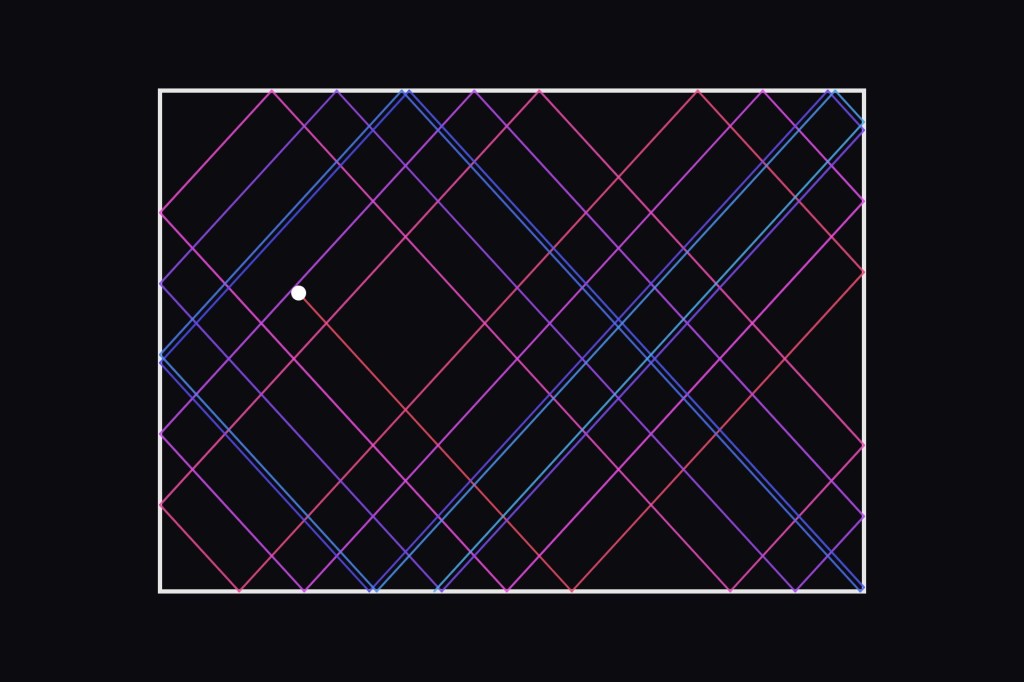
Imagine a billiard ball that is travelling around a table whose outline is a polygon rather than a rectangle. The ball moves in a straight line until it hits an edge; then, depending on the angle it hits the edge at, it bounces off and travels in the opposite direction. If you move the ball multiple times, again and again, will the ball eventually return to its starting point, will its path form a repeating pattern, or will something more complicated present itself?
Although the premise is simple, the long-term behaviour of the ball can be extremely difficult to predict. Mirzakhani worked with mathematician Alex Eskin, with some help from Amir Mohammadi, to investigate deep questions about the dynamics of surfaces and the structures generated by such systems. Their work revealed unexpected regularities in mathematical spaces where behaviour had seemed remarkably complicated and unpredictable. The billiard ball problem is not a complete description of their research, but it offers a glimpse of how an ordinary scenario can be a highly abstract mathematics problem. Their paper, published in 2013, was a substantial achievement in the field. Its importance was in proving results about the structure of certain dynamical systems that mathematicians had struggled to understand. A ball bouncing around a table might seem a long way from the geometry of a multi-holed surface, but both problems ask a similar question: how can complicated behaviour be determined by a fundamental mathematical structure?
Significance of the Fields Medal
In August 2014, Mirzakhani received the Fields Medal at the International Congress of Mathematicians in Seoul. The medal is awarded every four years to mathematicians for outstanding achievements. It is often described as the mathematical equivalent to a Nobel Prize. Mirzakhani was both the first woman and the first Iranian to receive it.
The award recognised the originality of her contributions to our understanding of the geometry and dynamics of Riemann surfaces and their moduli spaces. Women had historically been underestimated and overlooked at the highest levels of mathematics, so Mirzakhani’s achievement was an important moment of recognition. Mirzakhani herself hoped that her achievement would encourage other young women to pursue mathematics. Her success made her achievements visible, and her approaches to mathematics changed the way people approached problems.
Her working habits were just as unique as her research. She often spread large sheets of paper across a table or floor, filling them with drawings, diagrams, and equations. It is an image that challenges the familiar picture of maths as rows of numbers and symbols written in a notebook. For Mirzakhani, drawing was a way to think openly and to physically visualise her thinking. This was a method of exploring a problem before its structure became clear enough to be expressed in a proof.
Legacy
In 2017, Mirzakhani died at the age of 40, after being diagnosed with breast cancer in 2013. Her career was tragically short, but the influence of her research continues. She remains the only woman to have received the Fields Medal. It would be easy to remember Mirzakhani only through the extraordinary milestones of her life, but there is something more revealing in the way she approached difficult problems. She did not expect an immediate answer, and she did not treat slow progress as proof of failure. She was willing to remain with a question long enough for unexpected connections to appear. That attitude offered a useful perspective on mathematics itself. In school, the subject can sometimes feel like a race towards the correct answer.
Researching mathematics is about exploration, inevitable dead ends, partially formed ideas, and discoveries that only become meaningful after years of work. Mirzakhani’s career showed what can happen when imagination is given the same importance as calculation. Maryam Mirzakhani did not just solve difficult problems; she helped mathematicians rethink the way they approached questions.
References
Stanford University (2014). ‘Stanford’s Maryam Mirzakhani wins Fields Medal’. Stanford Report. Available at: https://news.stanford.edu/stories/2014/08/stanfords-maryam-mirzakhani-wins-fields-medal.
O’Connor, J.J. and Robertson, E.F. (n.d.). ‘Maryam Mirzakhani (1977–2017)’. MacTutor History of Mathematics Archive, University of St Andrews. Available at: https://mathshistory.st-andrews.ac.uk/Biographies/Mirzakhani/.
Institute for Advanced Study (n.d.). ‘Maryam Mirzakhani’. Available at: https://www.ias.edu/scholars/maryam-mirzakhani.
Fields Institute for Research in Mathematical Sciences (2017). ‘Maryam Mirzakhani, 2014 Fields Medal Winner, Dies at 40’. Available at: https://www.fields.utoronto.ca/news/Maryam-Mirzakhani-2014-Fields-Medal-Winner-Dies-40.




Leave a Reply