By Horn OS
1. Introduction
On the 23rd of September, Dr. Andras Hrasko, a renowned Hungarian mathematics researcher and educator, came to give a masterclass on Elliptic Curves to the Mathematical Society. Prior to this talk, he gave the Mathematical Society a set of problems to solve, each related in some way to the elements of his talk. The last of these problems was perhaps the most directly linked to elliptic curves, and was also the only problem to go unsolved. In this article I give a proof.
2. The Problem
Do there exist infinitely many primitive integer solutions to the equation ?
A solution is primitive if . We are interested in non-trivial solutions, those with , since the only primitive solutions with are and .
The answer is yes.
The method we will be using is to convert the original equation into an elliptic curve, find one rational base point, and prove that it is possible to find infinitely many more rational points on the curve, which can be transformed back into infinitely many integer solutions to the original equation. We will use the base case which clearly satisfies the equation.
3. Turning the Equation into an Elliptic Curve
An elliptic curve is a curve of the form . Its rational points (points whose coordinates are both rational) can be “added” together geometrically, which lets us build new points from old ones.
3.1 Forming an elliptic curve in Weierstrass form
Start with the original equation:
Rearrange it:
This is an equation of the form:
We first treat the general equation . Let:
Then
Assume . (For our equation , so would mean and hence , which is the trivial solution, so nothing is lost.) Divide by :
Crucially, this relates a square to a cube, so we can achieve a Weierstrass equation by rescaling the two ratios. Let:
These factors are chosen so that the coefficients of and come out equal. Hence:
Substitute back into the equation:
Which simplifies to:
For our original equation we have:
So our elliptic curve in Weierstrass form is:
Where:
Our base case therefore maps to the point on the elliptic curve. Checking that this point works:
3.2 Proving the converse
We need to make sure we can transform the rational points on our elliptic curve back into solutions to the original equation.
Start from:
Similarly, since ,
For our particular equation,
So:
To verify the converse works:
Which can be rearranged to:
Thus the transformation works in both directions. Any solution to with produces a corresponding point on the elliptic curve . And, any rational point on the elliptic curve provides a rational solution to the equation , which can be scaled up to an integer solution, with in the ratio .
4. Adding Points on an Elliptic Curve
To find more rational points on the elliptic curve, we must use the elliptic curve group law. It defines the addition of two points to find a third point on the curve, or the doubling of a single point to find another intersection point.
4.1 Addition
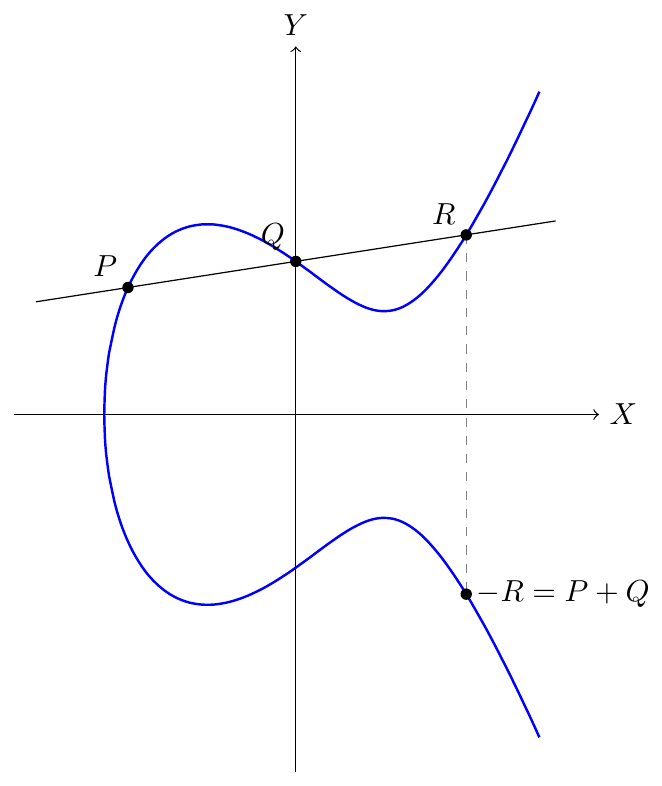
We have two points and on the curve, and we find the third intersection point of the curve with the line through and . We define
Where is the negative1 of , which is just its reflection in the -axis.
The point at infinity, denoted by , acts as the identity element. Consequently,
Figure 1: An elliptic curve, with a line through and intersecting the curve again at point . Reflecting in the -axis gives .
4.2 Finding
Let . Let the gradient of the line passing through those points be :
We must find the third intersection point. Take any elliptic curve and any straight line and equate them to each other.
Using Vieta’s formula for the roots of a cubic, we know that the three roots of this equation (i.e. the -coordinates of the three intersection points) sum to . Thus . To find we find the equation of the line:
Thus we have the coordinates of the 3rd intersection point . But we define , so we require , which is just reflected in the -axis. Thus:
4.3 Doubling
We have one point on the curve, and we find the other intersection point of the curve with the tangent line at . Since this case is essentially a variant of addition where , we define the doubling operation .
The only difference to the graph is the gradient of the intersecting line, which is found by differentiating the elliptic curve at the point . For our elliptic curve , let :
The gradient in this case is , so:
All the other equations remain the same for finding , except for the fact that .
5. Generating Solutions
We only started with one point , so to find a new point we must first double it to get . Let’s start with the gradient .
From this new point we can return to our original equation
Thus , , is another primitive integer solution to the equation . We can check this:
We can find further points by adding to , doubling , and so on. A remarkable (and non-obvious) fact is that this addition is associative and commutative, so different routes to the same multiple produce the same point on the graph. For instance, one could reach by adding to , or by doubling , but the coordinates of would remain the same regardless. Each new point produces a different solution to the original equation.
The next two points are:
Which produce primitive integer solutions to the original equation:
These calculations suggest that we can continue generating solutions indefinitely. However, computing more points is not a proof that the process never repeats. Thus, we must prove it some other way.
6. Infinitely Many Solutions
The order of a point on an elliptic curve is defined as the lowest possible positive integer such that , where is the point at infinity. We aim to prove that has infinite order on our elliptic curve . Suppose, for contradiction, that has finite order .
We use the reduction theorem for elliptic curves, which states that, for a rational torsion point of finite order , if the elliptic curve has good reduction at a prime ,
for some nonnegative integer , where is the reduction of modulo , and is its order in the finite group of points over .2
6.1 Good reduction
The curve has good reduction at a prime if does not divide its discriminant.
The discriminant of an elliptic curve is
For our elliptic curve, this discriminant is
Thus the lowest primes coprime to this are 5 and 11, and so they are the lowest primes of good reduction.
6.2 Reduction modulo 5 and 11
If we reduce the curve modulo 5 it becomes and point becomes . Thereafter:
Adding a point to its negative gives . Since the negative of a point is , a point with is its own negative, so doubling a point with results in the point at infinity . Thus:
As well, and . Since the order divides 6, this means , so:
for some nonnegative integer .
Reducing the curve modulo 11, it becomes and point becomes . Thereafter:
Thus:
As well, and . Since the order divides 12, this means , so:
for some nonnegative integer .
6.3 Contradiction
If had finite order, we would have
But these two expressions cannot be equal. If , the left-hand side is divisible by 5, whereas the right-hand side is not. If , the left-hand side is 6, whereas the right-hand side is at least 12. Both possibilities are impossible. Therefore, our assumption that has finite order is false, and
7. Conclusion
Since has infinite order, the points
are all distinct. Moreover, no is the negative of another , since that would give . Since the transformation can be inverted, distinct points give distinct ratios , so distinct multiples of yield distinct rational solutions of
(The points and would give the solutions and , which are essentially the same, which is why it matters that no two of our points are negatives of each other.) Scaling up or down as necessary produces primitive integer solutions. Hence there are infinitely many distinct primitive integer solutions to
Notes
- Also called the inverse of .
- is defined as the finite field of integers modulo .


Leave a Reply