By Solecki-Servi KS
1. Introduction
Whilst ordinary algebra primarily concerns solving equations, other algebraic structures address different questions. For instance, does the order of two rotations matter? How can a symmetry act on a system of several objects? These questions lead to two important structures: Lie algebras and Hopf algebras. In particular, Lie algebras study infinitesimal changes in continuous symmetries, and especially when the order of transformations matters, as the Lie bracket can function as a measure of a “failure to commute”. Hopf algebras describe how symmetries act when systems are combined, and include both groups and Lie algebras as examples.
In order to understand these algebras, we must be comfortable with the following essential notions:
A vector space over a field (such as the real numbers or the complex numbers ) is a collection of vectors that can be added and multiplied by scalars from .
A unital associative algebra is a vector space equipped with a bilinear multiplication (meaning that it is linear in each input separately) satisfying
For example, we can consider matrices, where , the space of matrices, forms an associative algebra under matrix multiplication.
2. Lie Algebras
2.1 Definition
A Lie algebra over is a vector space equipped with a bilinear operation , called the Lie bracket, satisfying and the Jacobi identity
It is important to note that the first axiom here in fact implies , since expanding using bilinearity gives
Hence, reversing the order of two elements reverses the sign of their bracket.
2.2 The Matrix Commutator
For matrices, we can define . This is called the matrix commutator, and acts as a measure of whether two transformations commute. If , their order does not matter, so the commutator yields zero. However, otherwise, the commutator is non-zero.
We can show that this operation in fact satisfies the Lie algebra axioms, and hence creates a Lie algebra. First, is evident, and secondly, the Jacobi identity follows by expanding the nested commutators and cancelling terms. Therefore, every associative algebra becomes a Lie algebra under the commutator bracket.
2.3 Example: Rotations in Three Dimensions
This particular example of matrices is actually very useful, as matrices can represent rotations in three-dimensional space. The infinitesimal generators of rotations about the coordinate axes, which describe very small rotations, are
These matrices describe how rotations begin to change a vector. An actual rotation through angle is obtained using the matrix exponential:
For example,
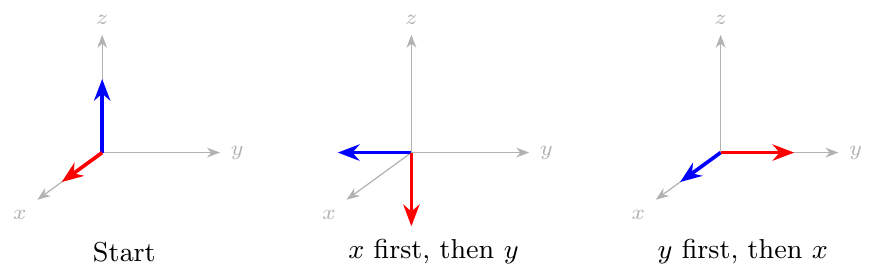
Now, we can consider two small rotations about the – and -axes, and look at their differences when swapping the order. Their order generally matters, as Figure 1 shows for large rotations, so and are usually different. Expanding the exponentials gives
where stands for terms involving and higher powers, which are tiny when is small. Direct multiplication shows that . Consequently,
The leading difference between the two compositions is governed by the generator of rotation about the third axis. The Lie bracket therefore predicts how the order of small rotations changes their combined effect.
2.4 Applications in Quantum Mechanics
The idea of Lie algebras is fundamental in the study of quantum mechanics. Angular momentum operators satisfy , with analogous relations obtained by cyclically permuting the axes. Since these operators do not commute, certain angular momentum components cannot simultaneously have arbitrarily precise values, a consequence of the uncertainty principle.
3. Hopf Algebras
Now, rather than considering infinitesimal symmetries, we will consider how a symmetry acts on a system made of two objects. Through the lens of quantum mechanics, if the two objects have state spaces and , the combined state space is the tensor product , a space built from pairs with and . This leads to the idea of a coproduct.
3.1 Definitions
A coalgebra consists of a vector space with linear maps and , called the coproduct and counit. While a multiplication combines two elements into one, the coproduct does the reverse, splitting one element into two. They satisfy
which means that splitting an element into three pieces gives the same result whichever of the two halves you split second, and
which means that splitting an element and then discarding one half changes nothing.
A bialgebra is both an associative algebra and a coalgebra, with compatible multiplication and coproduct, meaning that and respect multiplication: and .
A Hopf algebra is a bialgebra equipped with an antipode , generalising the idea of an inverse. Its defining property is
where . This shorthand, called Sweedler notation, writes the coproduct of as a sum of pairs, with standing for the first half and for the second half of each pair.
3.2 Example: The Group Algebra
For an example, it is interesting to consider group algebras. Groups by themselves describe symmetries, so are fitting. For example, the symmetries of an equilateral triangle, three rotations and three reflections, form the group .
Given a group , its group algebra is a vector space with basis the elements of , whose multiplication extends the group operation. For example, is a 6-dimensional algebra, with one basis element for each of the six symmetries of the triangle.
For each , define
These make a Hopf algebra. Note here that the coproduct sends a symmetry to the same symmetry in each tensor factor. Thus, describes that symmetry acting simultaneously on two systems.
4. Connecting Lie and Hopf Algebras
Lie and Hopf algebras are actually closely related. In order to find out how, we need to consider the universal enveloping algebra. Every Lie algebra has an associated universal enveloping algebra . It is constructed from the tensor algebra , which contains all products of elements of , by imposing the relations . Thus, the commutator of two elements agrees with their original Lie bracket.
Now, the universal enveloping algebra has a natural Hopf algebra structure. For every ,
The coproduct here describes how an infinitesimal symmetry acts on two systems, where its action on the combined system is the sum of its actions on each part.
The Poincaré–Birkhoff–Witt theorem guarantees that the original Lie algebra embeds into its universal enveloping algebra, so no information about is lost. Hence, every Lie algebra gives rise to a Hopf algebra, and Lie algebras can be studied using the tools of Hopf algebras.
5. Modern Applications
5.1 Quantum Groups and Integrable Systems
An interesting application of Hopf algebras is in quantum groups. Quantum groups are often constructed by deforming the universal enveloping algebra of a classical Lie algebra. We can consider , which depends on a parameter and recovers as .
Their coproducts are generally not cocommutative, meaning that , where swaps the two tensor factors. Thus, the order of tensor factors can matter. However, in these quantum groups, the effect of swapping the two tensor factors can be undone by a special invertible element , called the -matrix:
An important consequence is that the -matrix satisfies the Yang–Baxter equation:
Here, describes an interaction between the th and th tensor factors.
The equation states that two different sequences of pairwise interactions produce the same result. It is fundamental to integrable quantum systems, including certain quantum spin chains, where many-particle interactions can be analysed through simpler two-particle interactions.
5.2 Quantum Groups and Knot Theory
Quantum groups also connect abstract algebra to topology. A knot is a closed loop in three-dimensional space, and equivalent knots can be continuously deformed into one another without cutting or passing through themselves.
In fact, the Yang–Baxter equation is the algebraic form of one of the basic moves of knot theory: sliding a strand past a crossing of two other strands (the third Reidemeister move). This is exactly why -matrices can be used to study knots. Representations of quantum groups (ways of writing their elements as matrices) and their -matrices allow mathematicians to assign algebraic quantities to knots. By combining the rules for crossings with an appropriate trace, we get knot invariants, namely quantities unchanged under continuous deformation.
A famous example is the Jones polynomial, which can be obtained using suitable quantum group representations, and the Reshetikhin–Turaev construction develops this connection in general.
6. Conclusion
In conclusion, we have shown how Lie and Hopf algebras provide complementary ways of understanding symmetry, where Lie algebras measure how infinitesimal transformations combine, making them essential in rotations and quantum observables, and Hopf algebras extend this framework to systems composed of several parts. Together, they form an important mathematical foundation for quantum mechanics, integrable systems and knot theory.
If you would like to explore this topic further, I recommend An Introduction to Lie Groups and Lie Algebras by Alexander Kirillov, which provides a deeper introduction to the algebraic structures discussed in this article.
References
Jones, Vaughan F. R. “A Polynomial Invariant for Knots via von Neumann Algebras.” Bulletin of the American Mathematical Society, vol. 12, no. 1, 1985, pp. 103–111. https://doi.org/10.1090/S0273-0979-1985-15304-2.
Kassel, Christian. Quantum Groups. Graduate Texts in Mathematics, vol. 155, Springer-Verlag, 1995. https://doi.org/10.1007/978-1-4612-0783-2.
Kirillov, Alexander, Jr. An Introduction to Lie Groups and Lie Algebras. Cambridge Studies in Advanced Mathematics, vol. 113, Cambridge University Press, 2008. https://doi.org/10.1017/CBO9780511755156.
Reshetikhin, Nicolai, and Vladimir Turaev. “Ribbon Graphs and Their Invariants Derived from Quantum Groups.” Communications in Mathematical Physics, vol. 127, no. 1, 1990, pp. 1–26. https://doi.org/10.1007/BF02096491.



Leave a Reply