
By Austen
When we think about a general election, we usually picture politicians campaigning, people casting their votes and the results being announced. However, there is a mathematical side to elections. The way votes are counted can have a huge effect on which parties win power, even when millions of people vote.
Choosing a voting system is more complicated than it might seem. Ideally, everyone’s preferences should be represented fairly, but different systems produce different results. Mathematicians have studied this problem for centuries, and their work has shown that no voting system is perfect.

1. First Past the Post
First Past the Post (FPTP) is the voting system used in UK general elections. The country is divided into constituencies, and voters choose one candidate to represent their area. The candidate with the most votes wins the seat, even if they receive less than half of all the votes cast.
Although this system is simple, it can produce some surprising results.
One problem is known as the spoiler effect. Imagine that 60% of voters in a constituency support left-wing parties, while the other 40% support a right-wing party. If the left-wing vote is split between two candidates, receiving 31% and 29% respectively, the right-wing candidate could win with just 40% of the vote. As a result, the winning candidate might not represent the preferences of most voters.
Another issue is that some votes have little effect on the final outcome. In a constituency where one party wins comfortably in every election, voters supporting other parties may have little chance of changing the result. These votes are sometimes described as “wasted votes”.
This can encourage strategic voting. Rather than choosing their favourite candidate, people may vote for someone they think has a better chance of defeating a candidate they strongly oppose.
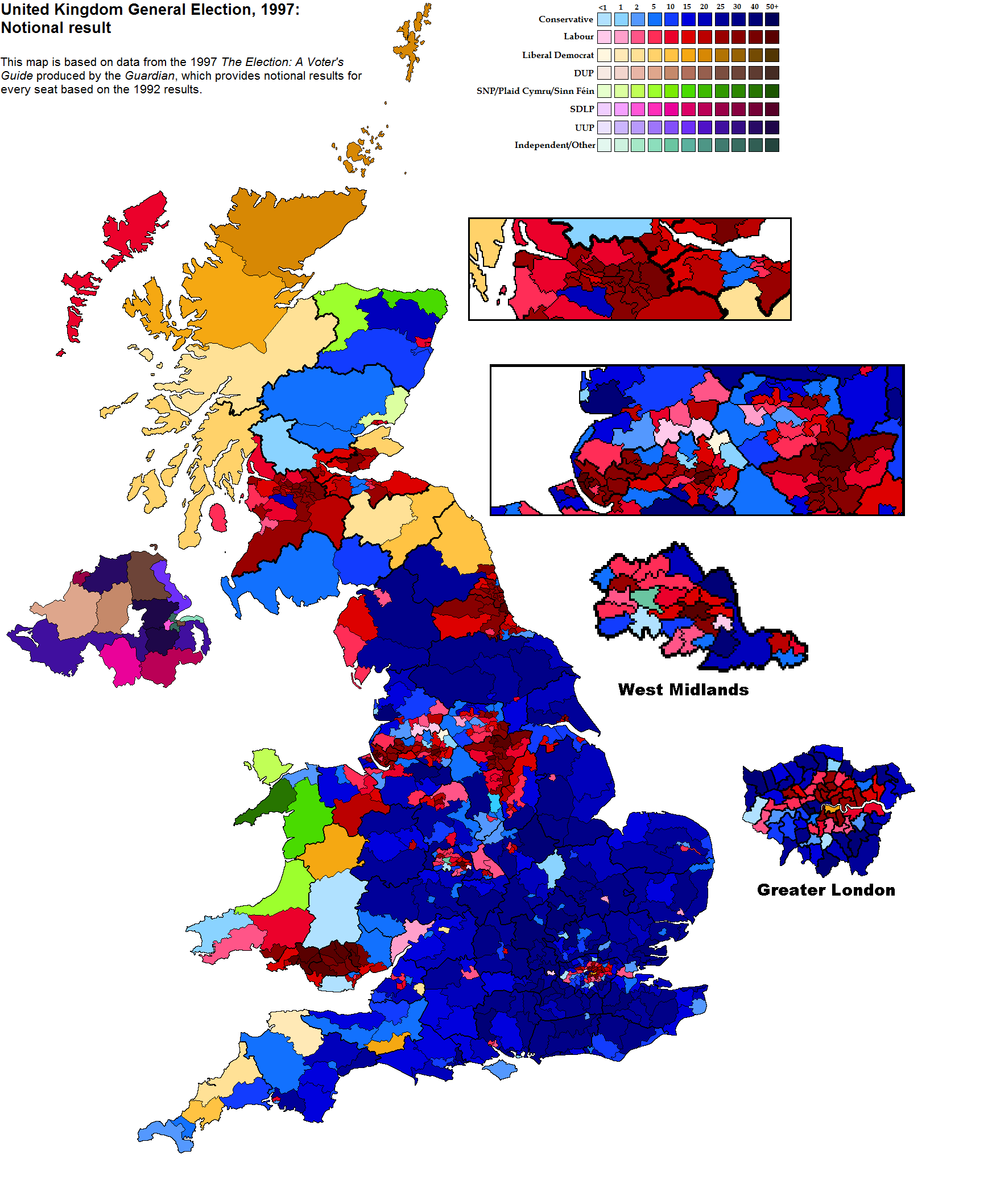
The 2024 UK General Election provides a good example of how FPTP can affect the outcome. Labour won approximately 33.7% of the votes cast across the country but secured around 63% of the seats in the House of Commons. This shows that winning the most votes nationally and winning the most seats are not necessarily the same thing.
Below: UK constituencies
2. Preferential Voting
An alternative approach is to allow voters to rank candidates in order of preference. Instead of selecting just one candidate, voters indicate their first choice, second choice and so on.
Under the Alternative Vote system, the first preferences are counted initially. If no candidate receives more than 50% of the valid votes, the candidate with the fewest votes is eliminated. Their votes are then transferred to the next preferred candidate who remains in the contest, according to each ballot paper.
This process continues until a candidate receives a majority of the votes remaining in the count.
The main advantage is that voters can support a less popular candidate without necessarily losing all influence over the result. If their first choice is eliminated, their next preference may still count. This can reduce the spoiler effect, although it does not remove every possible problem with strategic voting.
Australia uses this system to elect members of its House of Representatives. Candidates may therefore need to appeal to people who initially support other parties, as gaining second or later preferences can help them win.
3. Proportional Representation
Another approach is Proportional Representation (PR). The basic idea is that a party’s share of parliamentary seats should broadly reflect its share of the vote. For example, a party receiving around 30% of the vote should ideally win around 30% of the seats.
There are several forms of proportional representation, including party-list systems and systems that combine constituency representatives with additional seats allocated to parties.
Mathematics plays an important role in deciding how seats are distributed. One method uses the Hare quota, calculated by dividing the total number of valid votes by the number of seats being allocated. The resulting figure helps determine how many votes are needed to obtain a seat under the relevant electoral rules.
Proportional representation can also help smaller parties gain representation. Under First Past the Post, a party whose supporters are spread across many constituencies might win few or no seats, even if it receives a significant share of the national vote. Under a proportional system, that level of support is more likely to translate into parliamentary representation.
New Zealand uses a system called Mixed Member Proportional representation. Voters elect local constituency representatives and also vote for a political party. Additional seats help make the overall composition of Parliament more proportional to the party vote.
One possible consequence is that parties need to work together to form a government. Coalition governments can require compromise, although they can also make it more difficult for a single party to implement its policies.

4. Can Maths Save Democracy?
The difficulties involved in designing a fair voting system have interested mathematicians for centuries. In the eighteenth century, the French mathematician and philosopher Marquis de Condorcet studied situations in which voters’ preferences could produce contradictory results.
For example, a majority might prefer candidate A to candidate B, another majority might prefer B to C, and yet another might prefer C to A. This is known as the Condorcet paradox. It demonstrates that collective preferences do not always produce a clear or consistent winner.
Much later, economist Kenneth Arrow developed what became known as Arrow’s Impossibility Theorem. His work showed that, under certain assumptions, no ranked voting system can satisfy all of a specified set of fairness conditions at the same time. In other words, even carefully designed voting systems involve trade-offs.
This does not mean that every voting system is equally good or that fair elections are impossible. Rather, it shows that fairness can mean different things. One system may prioritise strong local representation, while another may aim to make parliamentary seats more closely match the national vote.
Ultimately, mathematics helps us understand the strengths and weaknesses of different electoral systems. It cannot tell us exactly which system a country should choose, because that depends partly on what its citizens value most. However, it can show us the consequences of those choices and help us make better-informed decisions about how democracy should work.




Leave a Reply