By Kolesnikov KS
1. Introduction
When you think of a one-line proof, you probably picture a counterexample or a claim so trivial that one sentence is enough. That makes it all the more surprising that Don Zagier proved the harder half of Fermat’s two-square theorem in a single sentence.
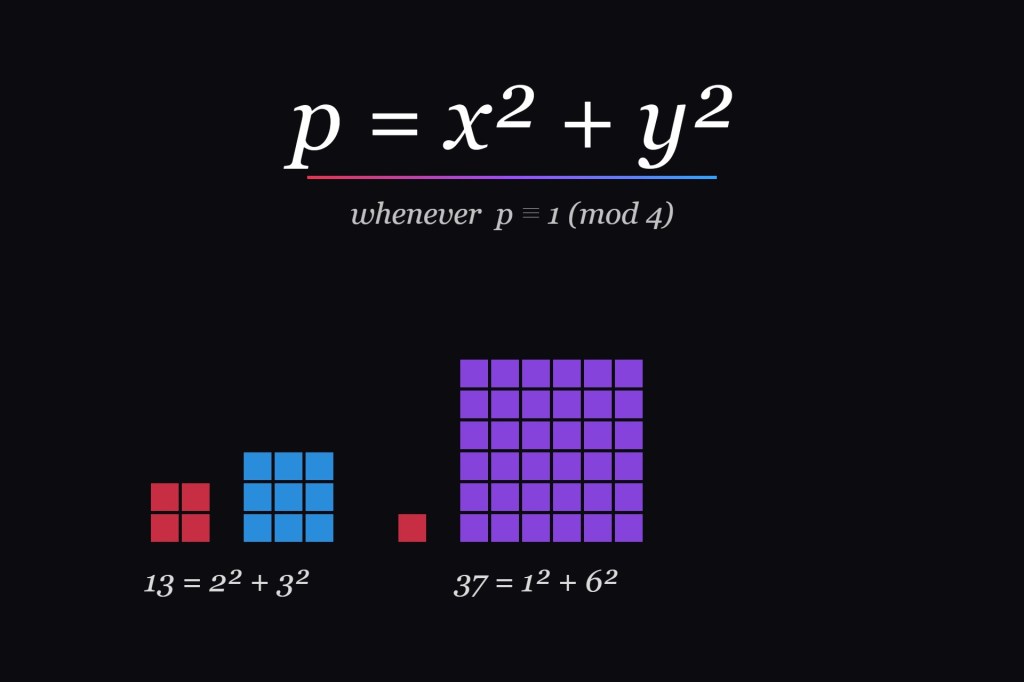
Fermat’s two-square theorem. An odd prime is a sum of two integer squares exactly when it leaves remainder 1 upon division by 4.
An even square leaves remainder 0 upon division by 4, and an odd square leaves remainder 1. An odd sum of two squares must use one of each, so it leaves remainder 1. For the converse, fix a prime . We want to show that for some positive integers and .
2. Setting Up the Proof
Zagier starts with and replaces one copy of with a new variable . Let be the set of triples of positive integers that satisfy
This set is finite. We have , and because . Since both and are positive, each is at most . A single triple in with gives the two squares we want.
The advantage of introducing is that swapping and keeps their product the same. Call this swap . Applying twice returns the original triple, so is an involution, a rule that undoes itself. Whenever moves a triple to a different one, it also moves that second triple back to the first. The only triples left unpaired are the ones leaves unchanged. These are its fixed points, and they are exactly the triples with . If has an odd number of triples, at least one must be left unpaired under .
3. Zagier’s Sentence
Zagier proves that the total is odd by giving the same triples different partners. His second involution, which we will call , leaves exactly one triple unpaired. In the original proof below, Zagier writes for our set , and for the positive integers.
A One-Sentence Proof That Every Prime
Is a Sum of Two Squares
D. Zagier
The involution on the finite set defined by
has exactly one fixed point, so is odd and the involution defined by also has a fixed point.
Don Zagier’s original proof, The American Mathematical Monthly, 1990.
4. Checking the Details
To justify the sentence, we need to check that sends every triple in to another triple in , that applying it twice returns the starting triple, and that it has exactly one fixed point. We take these in that order.
4.1 Every Triple Lands in
First, every triple must fall into one of the three rows. Since , the rows cover all values of except the two boundaries and . At the first boundary,
This would make a prime a square. At the second boundary,
which would make an odd prime divisible by 4. Thus exactly one row applies to each triple.
Now check the coordinates that row produces. In the first row, and are positive, while gives . In the middle row the two bounds give and . In the third row gives , and also . Every output is therefore a triple of positive integers.
It must also satisfy the same equation. For the first row, substitution and expansion give
For the middle row the corresponding calculation is
The third row gives this same expression because and have the same square, while swapping the last two coordinates leaves their product unchanged. Hence sends every triple in to another triple in .
4.2 The Map Undoes Itself
We can now check that undoes itself. Write . If the original triple uses the first row, then , and . Since
the new triple uses the third row. Applying that row returns the original coordinates, one by one:
Conversely, starting in the third row gives . Here
so the new triple uses the first row. It returns
The remaining possibility is the middle row, which gives
Before using the rule a second time, we must check that this new triple is still in the middle case. Its upper bound holds because
Its lower bound holds because
Thus , as required. Applying the middle row again now gives
All three cases therefore return the original triple after two applications. This proves that is an involution. Every triple that moves under belongs to a pair with the triple it moves to.
4.3 Exactly One Fixed Point
It remains to find the triples that stay put. The first and third rows move a triple to a different case, so a fixed point must use the middle row. There the first coordinate is unchanged exactly when
When , the third coordinate is unchanged too, because . Thus being fixed by is equivalent to having .
Substituting into the equation for gives
Both factors are positive integers, and . A prime has only the positive factors 1 and itself, so and . It follows that
This identifies the only possible fixed point. It really is in , since , and it lies in the middle case because . Substitution into that row gives
There is therefore exactly one fixed point.
5. Conclusion
We can now finish the counting argument. Apart from , every triple in has a distinct partner under . If there are such pairs, then
where means the number of triples in the set. So has an odd number of triples.
Return to the original swap . Its pairs each use two triples, so an odd set must contain at least one triple that the swap fixes. For that triple , and the defining equation becomes
These are the two integer squares whose existence we wanted to prove.
References
Zagier, Don. “A One-Sentence Proof That Every Prime Is a Sum of Two Squares.” The American Mathematical Monthly, vol. 97, no. 2, 1990, p. 144. https://doi.org/10.2307/2323918.



Leave a Reply