By Smith
1. Introduction
Artificial Intelligence has developed modern mathematics at speeds thought impossible only a few years ago. This article discusses the Millennium Prize Problems, including a possible AI solution to one of them, and then takes a deeper dive into one of the oldest and most famous problems in mathematics – the Riemann Hypothesis.
2. The Millennium Prize Problems
The Millennium Prize Problems are 7 incredibly difficult mathematical problems set by the Clay Mathematics Institute. Each carries a reward of 1 million USD for a solution. They were chosen at the turn of the century on the 24th May 2000. They are as follows:
- P versus NP Problem
- Riemann Hypothesis
- Yang–Mills Existence and Mass Gap
- Navier–Stokes Existence and Smoothness
- Hodge Conjecture
- Birch and Swinnerton-Dyer Conjecture
- Poincaré Conjecture
Of these problems, the only one officially recognised as solved is the Poincaré Conjecture, proved by Grigori Perelman, who turned down both the Fields Medal in 2006 and the prize in 2010. These problems were chosen for both their unparalleled difficulty and the profound consequences in science and mathematics for their solutions. The fields in which they are related to are explained below:
- It questions whether every problem which can be quickly verified by computer can be found quickly by a computer. If P = NP, and a practical fast method were found, much of global internet security including finance, digital signatures etc could be at risk, as most of these rely on mathematical problems that are difficult to reverse engineer such as large number factorisation. It is the most famous computer science question of all time.
- Discusses non-trivial zeros. Literally asks “do all non-trivial zeros lie on the critical line?”. This also holds the answer to how accurately we can predict the frequency of primes. Also, arguably the most important and difficult unsolved mathematical problem, dating back to 1859. Part of Hilbert’s 23 problems of 1900.
- It is related to quantum field theory and particle physics. It questions whether a quantum Yang–Mills theory exists in four-dimensional space, and whether it has a ‘mass gap’, meaning that the lightest particle it predicts must have a mass greater than zero. It relates heavily to the strong nuclear force.
- It is connected to fluid dynamics. It inquires if smooth, physically possible solutions can always exist for equations that describe fluid motion.
- It asks whether complex geometric shapes (projective algebraic varieties) can be broken down to mixes of simpler, geometric-algebraic foundations (algebraic cycles).
- Connected to elliptic curves (part of arithmetic geometry). It questions if it is possible to tell whether an elliptic curve equation has a finite or infinite number of rational number solutions.
- About the geometry of 3D shapes. It states that every simply connected, closed 3D space is equivalent to a sphere (topologically). This has been solved, hence why it is stated rather than questioned.
3. On the Navier–Stokes Problem
Recently, in September this year, OpenAI announced a possible solution to the Navier–Stokes Existence and Smoothness Problem (No. 4 above). Around 10,000 Artificial Intelligence agents worked for around 88 hours, using an estimated $15 million of computing power, to produce a proof, which was then checked using Lean. (Lean is a programming language that checks every step of a proof by computer, to avoid human error in complicated solutions.) However, before we can discuss the solution we must ask – what does the Navier–Stokes Existence and Smoothness problem intend to prove and why?
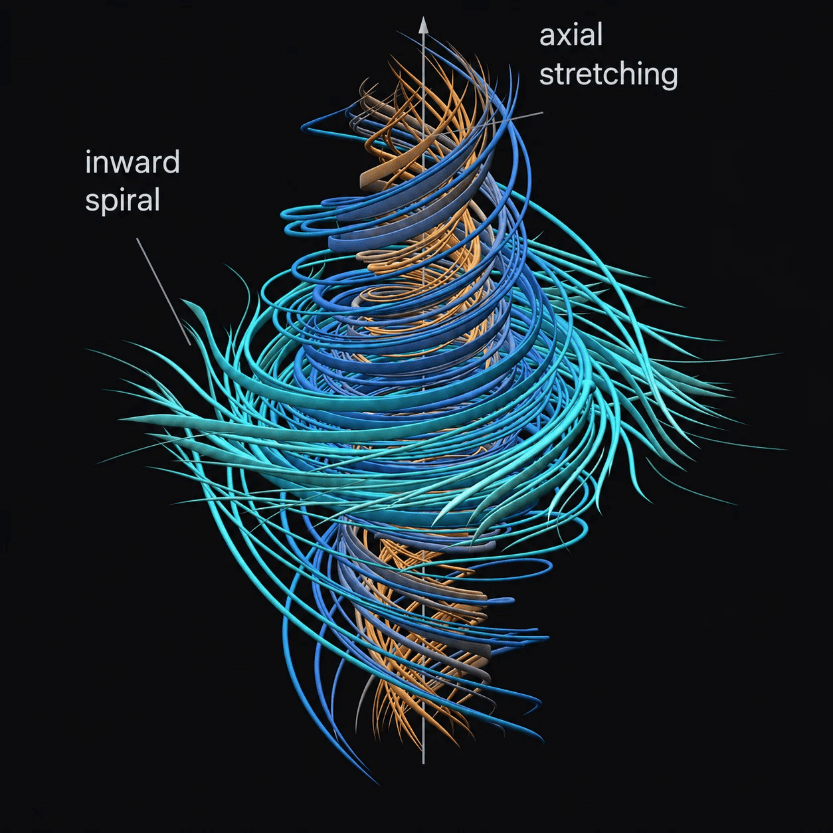
The Navier–Stokes Existence and Smoothness problem asks whether the equations which predict the movements of fluids, such as the turbulent air streaming past a jet in flight, always have sensible solutions. The solutions must be smooth – where the velocity and pressure have defined derivatives everywhere and don’t suddenly jump or break. The equations (simply put) use Newton’s Second Law – – and apply it to the motion of fluids. OpenAI’s system found that, in a model of a vortex which is pushed by a smooth outside force, a singularity (where something breaks and normal maths and physics don’t apply) can develop in a finite amount of time. This means that smooth solutions do not always exist, which, if confirmed, would settle the problem in the negative. However, the proof is still being checked by mathematicians and has not yet been recognised by the Clay Mathematics Institute, and two human mathematicians, Tristan Buckmaster and Levent Alpöge, posted closely related results only hours earlier.
4. The Riemann Hypothesis
Now, the Riemann Hypothesis, one of the oldest and most famous unsolved problems in mathematics. In the modern world of mathematics, hundreds upon hundreds of mathematical proofs and statements all begin with “If the Riemann Hypothesis holds, then…”. So, what is the Riemann Hypothesis?
This hypothesis links to one of the simplest concepts of mathematics: prime numbers. We studied them several years ago and yet they link to the hardest problem in maths. Specifically, the distribution of prime numbers.
4.1 Infinite Series and the Zeta Function
Firstly, we need to talk briefly about infinite series. These are the sums of sequences. Some add up to become infinity, such as and so on; this is known as a divergent series. However, some series add up to a fixed value, such as , extending to infinity. The total sum of this series is 1. The famous mathematician Leonhard Euler managed to find the sum of the series of 1 over the squares of all the positive integers, which strangely enough converges to an expression involving ,
He also then discovered the sums of the same series but to the power of 4 and 6 and 8 and so on. If we define as the power exponent, then a function of using zeta, , becomes the zeta function, .
Euler also discovered another way to express the zeta function: as an infinite product, with one infinite series for each prime number, made up of 1 over the powers of that prime. Multiplying all of these infinite series together also gives the zeta function.
4.2 Complex Numbers
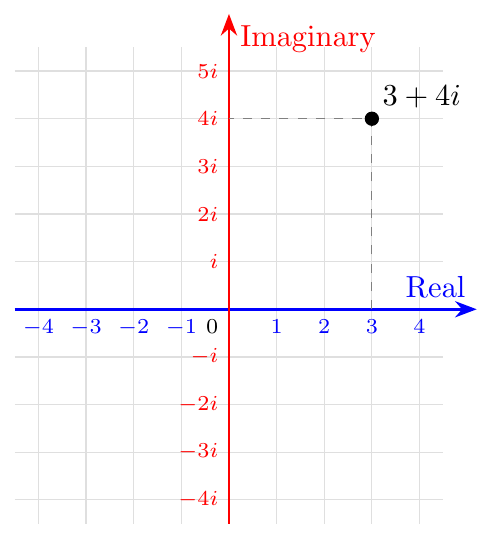
Finally, onto the main man himself, Bernhard Riemann. Riemann was one of the pioneers of complex analysis, where you can apply complex inputs and outputs to functions. Normally you can’t have the square root of , as no real number squared gives . However, if we let , a new ‘imaginary’ number, and then add or subtract a real number like 2, it becomes a complex number. Every complex number is made of a real part plus a multiple of , for example . Now, because complex numbers have a real part and an imaginary part we can plot these two values on the 2 axes of a graph: the imaginary part on the -axis and the real part on the -axis. This is called the complex plane (see Figure 2).
4.3 The Riemann Zeta Function and its Zeros
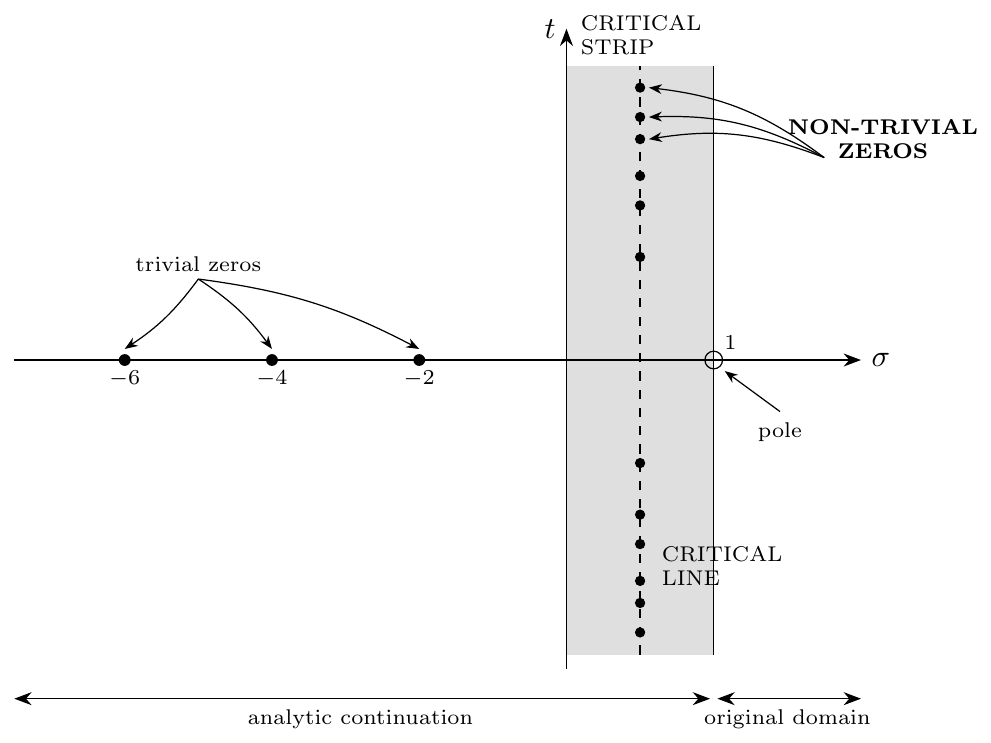
Riemann had an ingenious idea to use complex numbers as in the zeta function. When he did so, the sum would spiral in towards a single value. However, again the real part of must be greater than 1 for the series to converge to a single value. So, Riemann now had another brilliant idea: to extend the zeta function to the rest of the complex plane using analytic continuation (in simple terms, this is a way of extending the domain of a function, although the maths behind it is very hard). We now have a new function, the Riemann zeta function. Riemann discovered that for this function there are some inputs which have zero as an output, and each of these is known as a zeta zero. When you enter any negative even integer into this function you get zero – the so-called trivial zeros.
However, there are also zeta zeros that aren’t negative even integers, and these are called non-trivial zeros. All of them lie in the region between the lines where the real part of is 0 and 1, known as the critical strip. Riemann conjectured that, in fact, they all lie exactly on the line where the real part of is – all infinitely many of them as they extend to infinity. This line is known as the critical line, and this is the key point of the Riemann Hypothesis: do all the non-trivial zeta zeros lie on the critical line? Computers have checked the first ten trillion zeros and every one lies on the line, but no one has been able to prove that they all do. This problem holds the 1-million-dollar prize and would tell us exactly how accurately we can predict the distribution of prime numbers.
Edit
Very recently, after this article was written, the Riemann Hypothesis itself made headlines. On 20 November 2026, Levent Alpöge, a mathematician at Anthropic and one of the two mathematicians mentioned in the Navier–Stokes section above, announced a proof of the Riemann Hypothesis produced with the AI model Claude. Reports say it also covers the stronger generalised Riemann Hypothesis. The proof is written in Lean, and independent mathematicians have already compiled it successfully, so a computer has accepted every step. However, no human-readable version has been released yet, so nobody can yet explain why it works.
On the same day, Alessandro Masullo, a postdoc at Stanford, posted a separate, entirely human proof of the generalised Riemann Hypothesis, which is still being revised. Neither claim has been accepted yet: the Clay Mathematics Institute only awards its prize two years after a proof has been published and generally accepted.
References
“AI Claimed a Solution to the 167-Year-Old Riemann Hypothesis – and a Human Did, Too.” TechCrunch, 20 November 2026. https://techcrunch.com/2026/11/20/ai-claimed-a-solution-to-the-167-year-old-riemann-hypothesis-and-a-human-did-too/.
“Dueling Claims of Riemann Hypothesis Proofs Emerge.” Scientific American, 20 November 2026. https://www.scientificamerican.com/article/dueling-claims-of-riemann-hypothesis-proofs-emerge/.
Carlson, James, Arthur Jaffe, and Andrew Wiles, editors. The Millennium Prize Problems. Clay Mathematics Institute and American Mathematical Society, 2006. https://www.claymath.org/resource/book-title-the-millennium-prize-problems/.
“Mathematicians Still Checking the Navier–Stokes Proof That OpenAI Claims to Have Solved.” The Tufts Daily, 24 September 2026. https://www.tuftsdaily.com/article/2026/09/mathematicians-still-checking-the-navier-stokes-proof-that-openai-claims-to-have-solved.
“On the Navier–Stokes Millennium Prize Problem.” OpenAI, 8 September 2026. https://openai.com/index/navier-stokes-solution/.




Leave a Reply