By Zhong KS
1. Introduction
If you were to look closely at the centre of a sunflower, you would find an intricate arrangement of seeds, which form spirals that wind in opposite directions. So what causes this? Why should numbers from a mathematical sequence appear in a living plant? And what could an irrational number have to do with the arrangement of seeds?
The Fibonacci sequence is a sequence of numbers in which each term, excluding the first two terms, is the sum of the previous two terms. Although it is a simple rule, the sequence is associated with patterns found in sunflowers, pinecones, and several other plants, particularly in the arrangement of their leaves, flowers, and seeds, a phenomenon known as phyllotaxis. The sequence is also closely connected to the golden ratio, an irrational number approximately equal to 1.618.
This article explores the mathematical properties of the Fibonacci sequence, its relationship with the golden ratio, and examples of related patterns in the natural world.
2. The Fibonacci Sequence
In the Fibonacci sequence, each term is the sum of the previous two terms, usually starting with 0 and 1.
The rule for terms with is as follows:
For example, using the rule,
This rule produces the sequence: 0, 1, 1, 2, 3, 5, 8, 13, 21, 34, …
3. The Golden Ratio
The Fibonacci sequence is closely connected to the golden ratio. The golden ratio is represented by the Greek letter , and is defined as follows:
When consecutive terms are divided in the Fibonacci sequence, the results approximately approach the golden ratio:
This can be expressed as
In other words, as approaches infinity, the ratio of consecutive Fibonacci numbers approaches the golden ratio .
The relationship between the Fibonacci sequence and the golden ratio can be explained by considering the limit of the ratio of consecutive terms. Let and suppose that this ratio approaches a limit .
Dividing by ,
By definition, , so . Hence,
Assuming that the sequence of ratios converges to a limit , we also have . Therefore,
Using the quadratic formula, we find
Since all the ratios are positive, their limit must be non-negative. The equation rules out , so we take the positive solution.
4. Examples in Nature
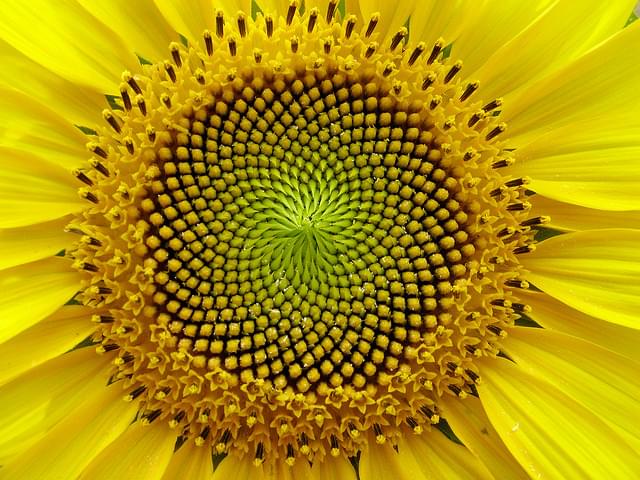
The seeds in a sunflower head grow in two families of spirals, winding clockwise and counterclockwise. The numbers of spirals in the two groups are often consecutive Fibonacci numbers, such as 34 and 55, 55 and 89.
The successive seeds in a sunflower head are often separated by an angle of approximately , known as the golden angle.
The golden angle can be calculated using the following formula.
Using the identity , we obtain . Therefore, the golden angle can also be expressed as
The golden angle helps prevent successive seeds from aligning along the same radial direction, contributing to a more uniform distribution of seeds. Angles that differ from the golden angle produce different patterns, while the resulting arrangement also depends on the plant’s growth and developmental processes. As the mathematician Ian Stewart explains, the golden angle promotes, but does not guarantee, efficient packing.
Many plants with spiral arrangements display patterns associated with Fibonacci numbers, as these patterns can promote more uniform spacing. For leaves, this arrangement can reduce overlap and allow greater access to sunlight, while in sunflowers or pinecones, it can contribute to more efficient packing. These growth patterns vary between species and are also influenced by other biological processes. The plants themselves do not consciously follow any mathematical rules. Instead, the Fibonacci sequence provides a useful model for the patterns that emerge during plant growth.
4.1 Phyllotaxis
The natural arrangement of leaves, flowers, or seeds around a growing point on a plant stem is known as phyllotaxis. Sunflowers provide a clear example of spiral phyllotaxis. Many plants with spiral phyllotaxis exhibit spiral counts that correspond to consecutive Fibonacci numbers. Pinecones, for example, can display two opposing families of spirals, similar to those found in sunflower heads.
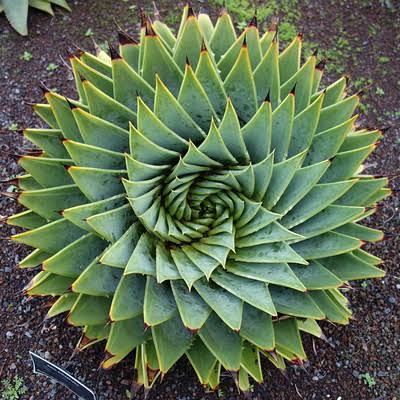
In alternate (spiral) phyllotaxis, one leaf emerges per node, and each successive leaf grows rotated around the stem of the previous leaf to form a spiral pattern, as shown in Figure 2. For many plants exhibiting spiral phyllotaxis, the angle between successive leaves is close to the golden angle of approximately . This arrangement can reduce leaf overlap and improve sunlight exposure.
5. Limitations of the Model
Although Fibonacci-related patterns are frequently observed in plants, they do not occur in all plant species. Plant growth can also be influenced by environmental, genetic, and developmental factors. In fact, in a 2016 study, scientists studied 657 sunflowers to see how many of them followed the usual Fibonacci patterns. In the most reliable data, about 82% of the spiral counts were Fibonacci numbers, but about 18% were not. Some sunflowers followed related sequences instead, such as the Lucas numbers (2, 1, 3, 4, 7, 11, …), which follow the same rule but start differently, or double Fibonacci numbers, while others had spiral counts one less than a Fibonacci number. Moreover, observing Fibonacci numbers in a plant does not prove that the plant itself follows the Fibonacci sequence. The Fibonacci sequence is a useful model for understanding patterns in nature but is not a universal law determining plant growth.
References
Grigas, Anna. The Fibonacci Sequence: Its History, Significance, and Manifestations in Nature. Senior Honors Thesis, Liberty University, 2013. https://digitalcommons.liberty.edu/honors/334/.
Stewart, Ian. Life’s Other Secret: The New Mathematics of the Living World. John Wiley & Sons, 1998.
Swinton, Jonathan, Erinma Ochu, and the MSI Turing’s Sunflower Consortium. “Novel Fibonacci and Non-Fibonacci Structure in the Sunflower: Results of a Citizen Science Experiment.” Royal Society Open Science, vol. 3, no. 5, 2016, article 160091. https://doi.org/10.1098/rsos.160091.
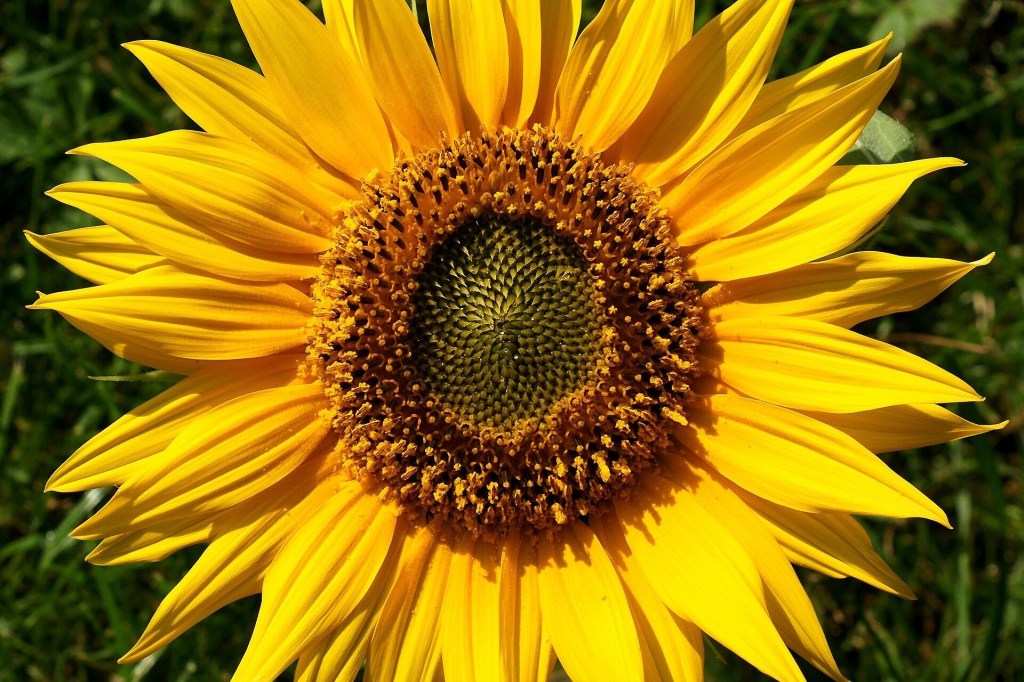
Cover photo: Sonnenblume Helianthus by Böhringer Friedrich, CC BY-SA 2.5, via Wikimedia Commons.


Leave a Reply