By H Man
for more than once
1. History
The notion of a rusty compass was first documented to be studied by Persian mathematician Abu al-Wafa’ Buzjani in the 10th century. He made pioneering contributions to astronomy, trigonometry, and spherical geometry, and his treatises, especially his own Almagest, were influential to medieval Arabic astronomers in the centuries after his death. The rusty compass refers to a compass with a fixed opening (i.e. it could only draw circles of a fixed radius), and its study was initially motivated by applications in geometric drawing and design: hinged compasses at the time grew inaccurate after repeated use, and accuracy was paramount for uses in decorations in Islamic architecture. Centuries later, such constructions also appeared in the drawings of Leonardo da Vinci and Albrecht Dürer.
Six centuries later, amidst the feuds between some Italian mathematicians, Tartaglia proposed four challenges to Ferrari, a disciple of his nemesis Cardano. These duels are best known for the cubic equation, which would have a profound impact on the development of mathematics and science. These four questions, however, were on constructions with the rusty compass. Ferrari was able to solve them by showing that it is possible to construct the first six books of Euclid’s Elements, and both of them were eventually able to show that all of the Elements were constructible by rusty compass.
In the 17th century, Danish mathematician Georg Mohr showed independently in Euclides Danicus that anything constructible by straight-edge and compass were also constructible by compass only. Unfortunately, he made the fatal mistake of publishing his work in Danish and Dutch, which nobody else could read. As a result, his findings were forgotten until the rediscovery of his work in 1928, after which the result for compass only construction was attributed to him and Lorenzo Mascheroni, who independently discovered it in 1797, as the Mohr-Mascheroni theorem.
Motivated by Mascheroni’s work, French mathematician and engineer Jean Victor Poncelet conjectured in 1822 that the same might hold for the rusty compass, and that it may only need to be used once. This was later shown by Jakob Steiner in 1833, and is now known as the Poncelet-Steiner theorem.
2. Proof
The theorem states that, given a single circle together with its centre, any point which can be constructed by straight-edge and compass can also be constructed by the straight-edge alone. It is worth highlighting what is meant by this exactly. With these restrictions, it is obviously impossible to create any construction involving more than one circle in the aesthetic sense. However, if we treat the result of a construction as the set of points produced by the intersection of circles and lines, it is meaningful to say we have made the same construction by constructing the same points.
The centre really is needed: Hilbert showed that with the straight-edge alone it is impossible to find the centre of a given circle, so without it the theorem would not hold.
It suffices then to show that all basic constructions involving the compass and straight-edge can be done by the straight-edge and starting circle alone, since all constructions can be expressed as a chain of the five basic moves:
- to draw the line through two points
- to draw the circle with centre at one point and circumference at another
- to find the intersection of two circles
- to find the intersection of a circle and a line
- to find the intersection of two lines
For the first two moves, we can consider the line and circle to be given with any two points. We write for the implied circle with centre and circumference through : we never draw it, but we know everything we need about it. Since we are only concerned with constructing all points constructible by straight-edge and compass, only the last three moves need to be considered. Since we have unrestricted use of the straight-edge, move 5 is trivial.
Though the other two are trivial with a compass, they seem very challenging with the straight-edge only, so it makes sense to think about what we can do with the straight edge by itself and how we might use the given circle. The only immediate use which comes to mind is that two equal segments are created on a line passing through its centre.
See figures on the final page for all constructions
2.1 Parallels
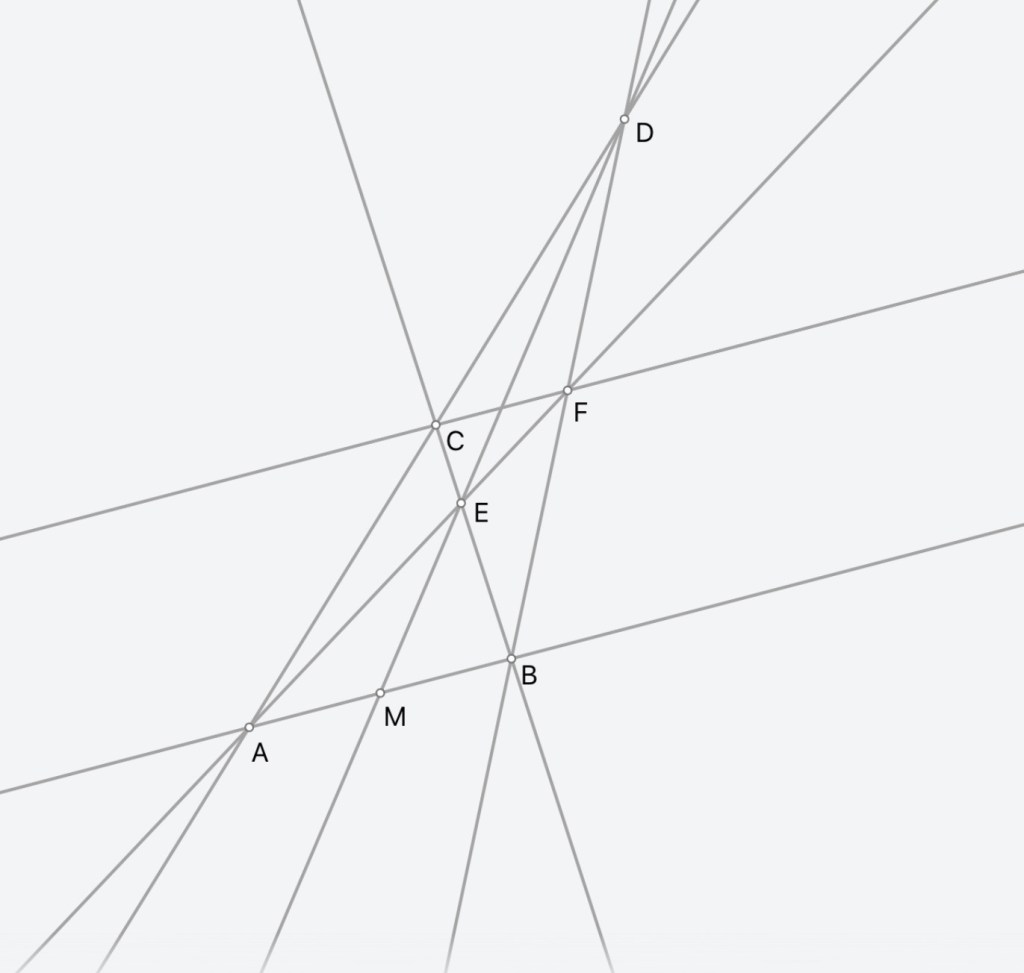
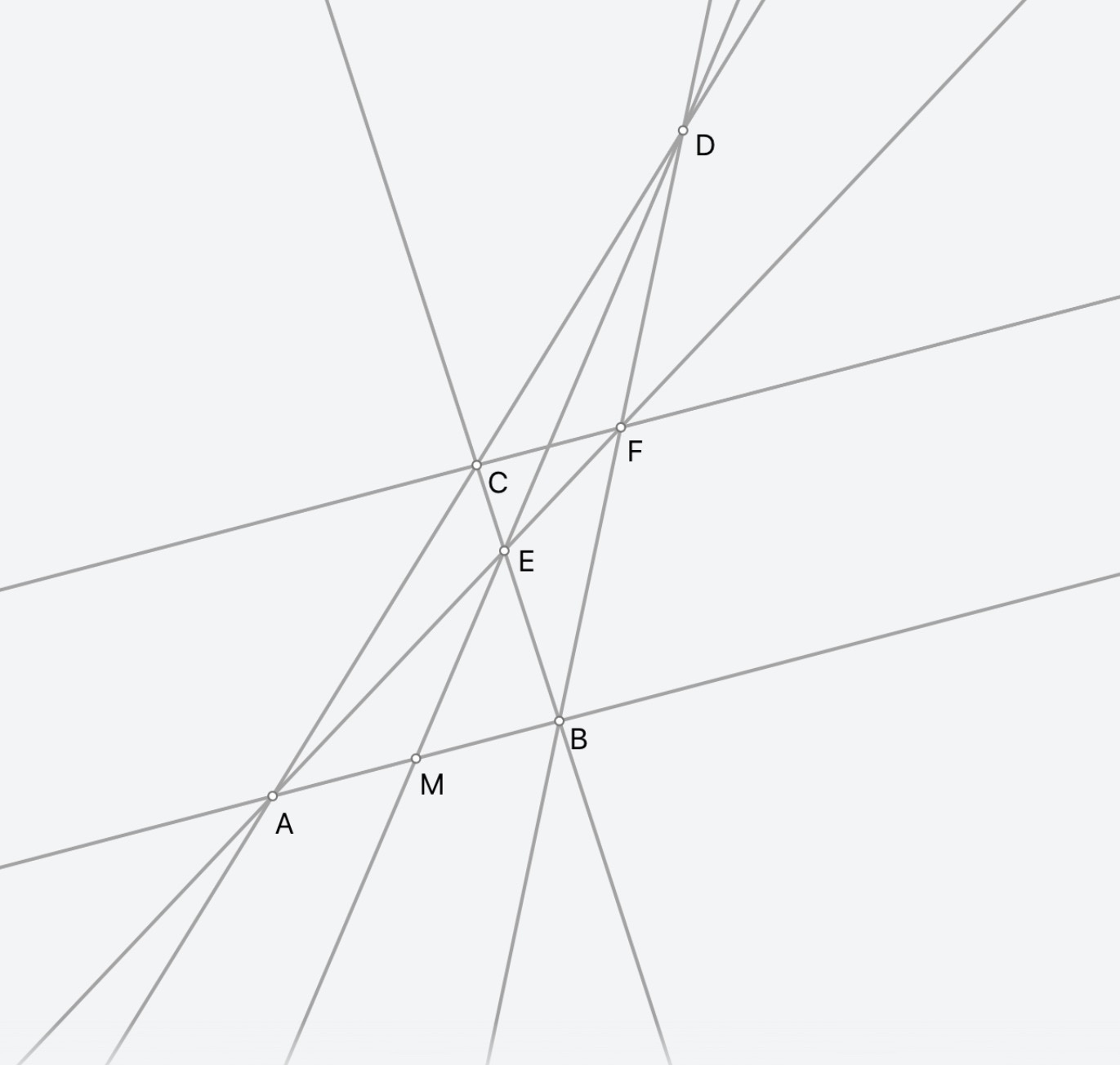
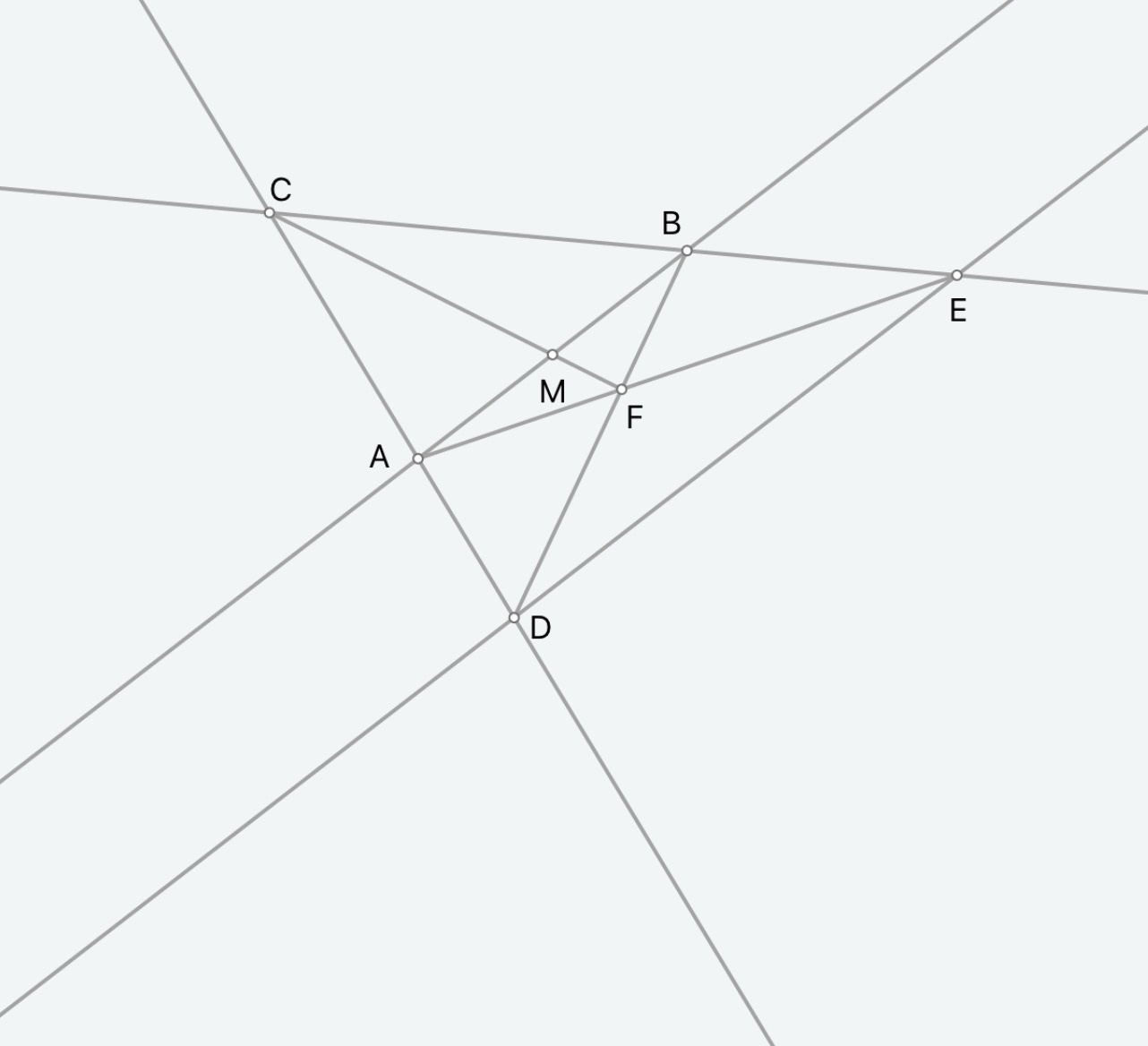
Given this bisected segment with midpoint , we can construct a parallel of it through :
- construct and
- take any point on
- construct , ; meets at
- construct , it meets at
- construct , which is parallel to
The validity of this construction can be quite easily shown by Ceva’s theorem: in triangle , the lines , and all pass through , so
Since , this gives , so is parallel to by the intercept theorem.
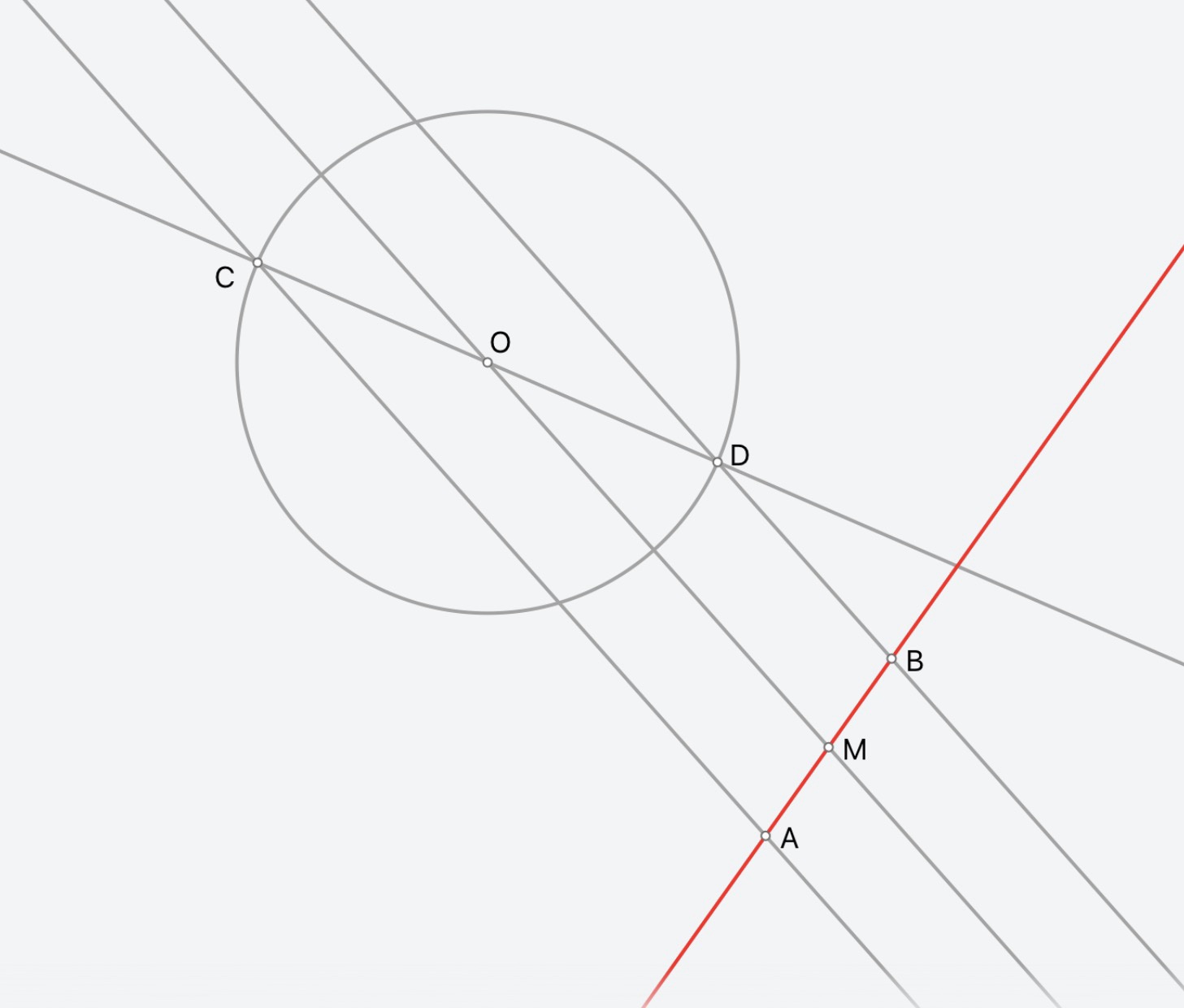
We can also create this bisected segment for any line (red) as follows:
- take any point on the line and construct
- take any point on the circle (not on ) and construct , which intersects the circle again at
- construct parallels to through and (we can do this because passes through the centre, so the circle cuts a diameter out of it which is bisected at )
- they intersect the red line at and , and bisects , since bisects
It follows then that we can construct parallels of any line.
2.2 Perpendiculars
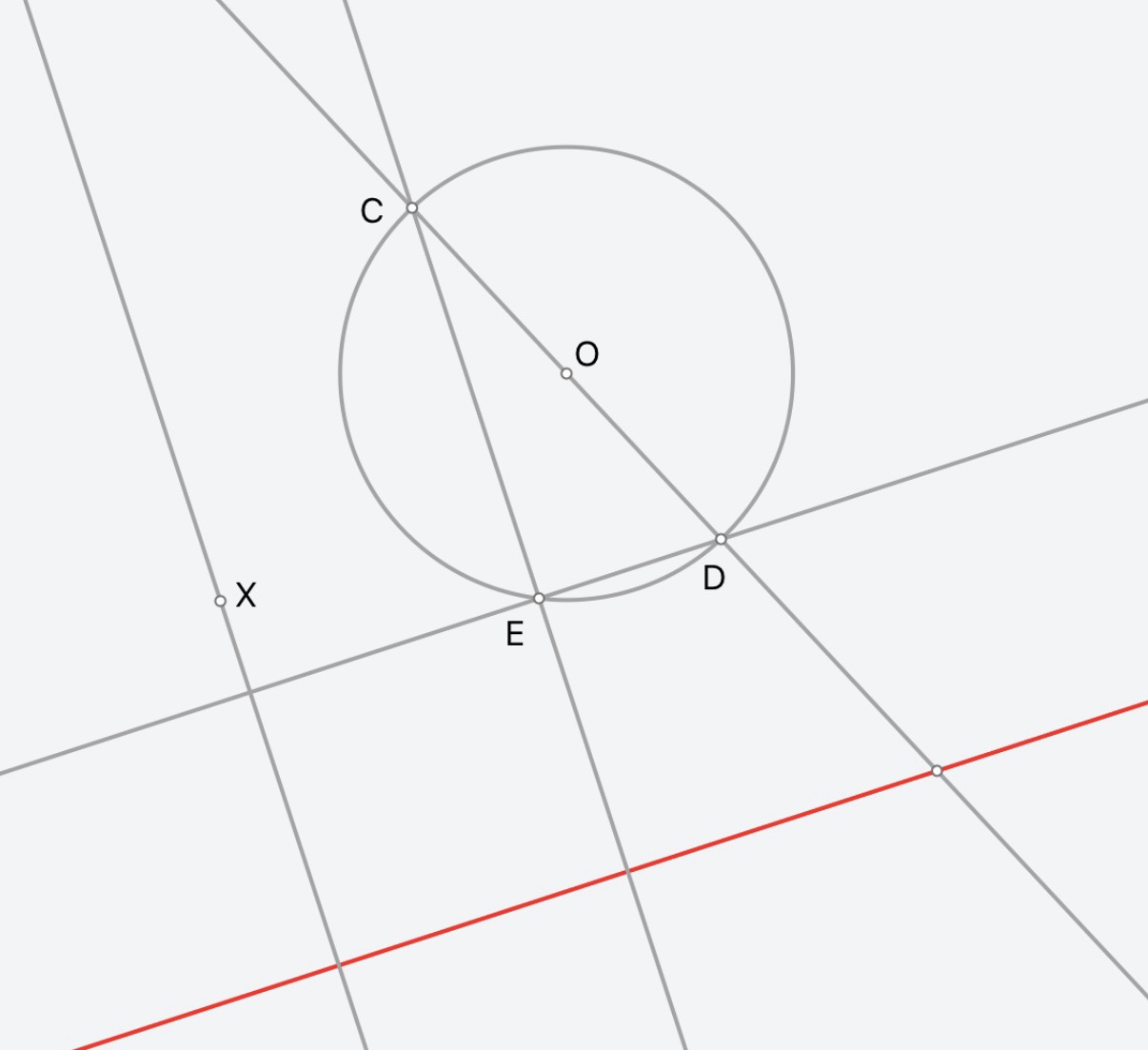
This gives us an easy way to construct perpendiculars of any line (red) through any point because of Thales’ theorem:
- construct an arbitrary line (which is not parallel nor perpendicular to the red line) through intersecting the circle at and
- construct the red line’s parallel through , it intersects the circle again at
- construct , then its parallel through , which is perpendicular to the red line
2.3 Midpoints
We can also reverse-engineer how we used the similar triangles earlier to now construct midpoints of segment :
- choose an arbitrary point not on the line, then construct ,
- construct any parallel to , intersecting at , at
- construct and , which intersect at
- construct , which intersects at , the midpoint
2.4 Line and Circle
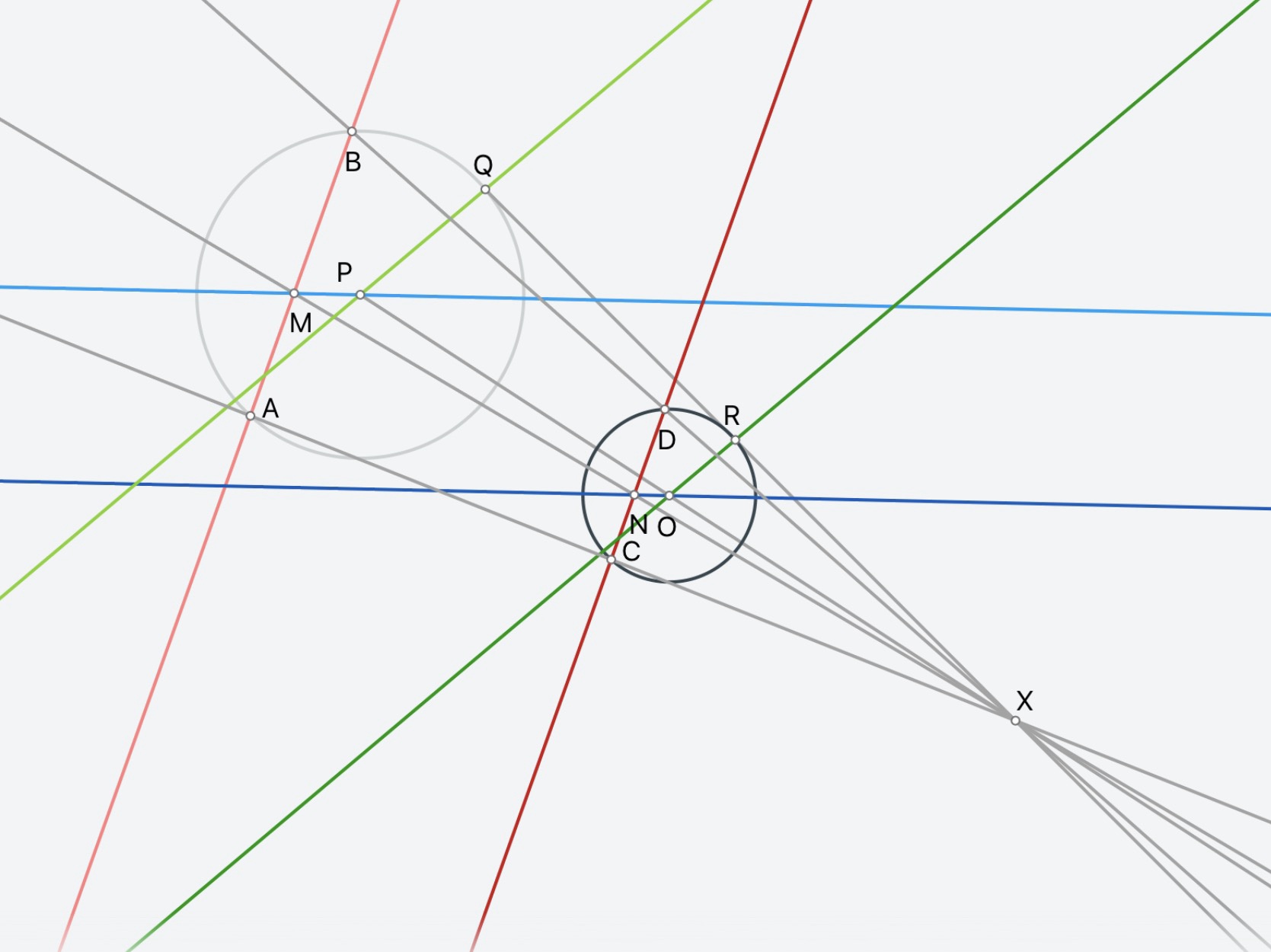
This gives us enough tools to intersect a line and a circle. We can take advantage of the fact that there is homothety (enlargement) which maps the implied circle we want to intersect to the given circle centred at . We then transfer the situation to the given circle, find the intersections, and map those back to . We start with the pink line with an arbitrary point on it.
- construct (light green) and its parallel through (dark green) which intersects the circle at (we take as the intersection on the same side of as ).
- construct (light blue) and its parallel through (dark blue)
- construct and , which intersect at , the centre of homothety
- construct , which intersects the dark blue line at
- construct the parallel of the pink line through , which intersects the circle at ,
- note that the dark lines, and therefore the triangle created by them, are the image of the light lines and their triangle by the homothety; this means that and are the image of the two intersections we are looking for
- construct and , which intersect the pink line at and , the intersections of the pink line with the implied circle
There are four steps in this construction which might not be possible if the points are specially placed: see if you can find them. If this happens, we can take some other point as the centre of an intermediary homothety with scale factor , and construct the images of and which are the midpoints of and . The rest is a similar construction to the one shown above.
2.5 Two Circles
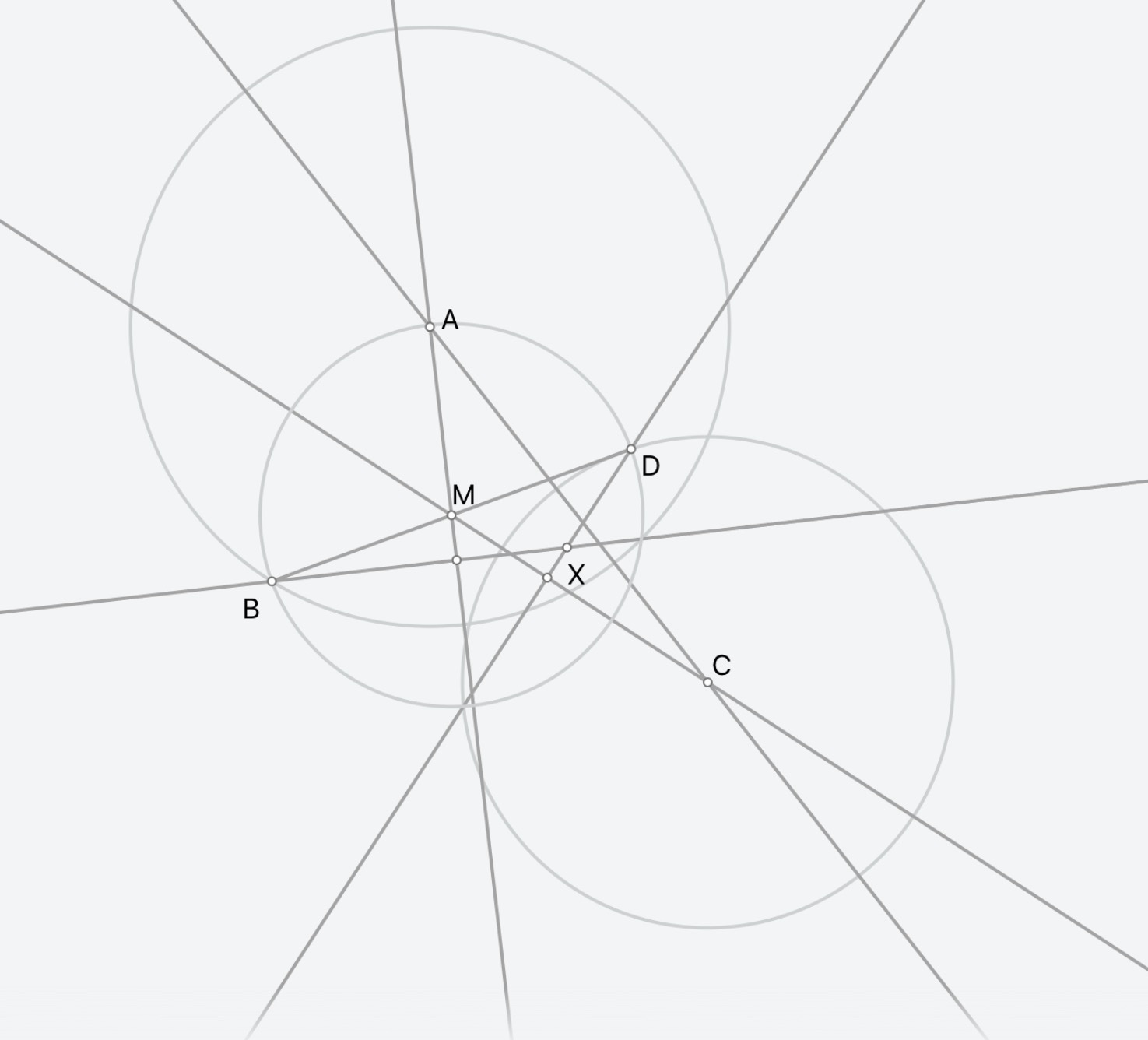
Intersecting two circles is trickier. We have the basic tools for the lines, but in order to construct the intersection between two circles, we need two lines we can construct which also meet at their intersection. It makes sense then to consider if we can construct the line which goes through both intersections, since it is perpendicular to the line through the centres and seems fundamental. This line is more generally (for circles which don’t intersect) known as the radical axis, which is the line of points with equal power to both circles. Starting with implied circles and , we can construct it as such:
- construct and , then which is the midpoint of
- now consider the implied circle , its radical axis to is perpendicular to and through , since lies on both circles, likewise for
- construct the perpendicular to through and the perpendicular to through , which intersect at
- since is where the axes intersect, it has equal power to as and by transitivity; it must lie on the axis we are looking for
- construct the perpendicular from to , which is our axis
If , and happen to lie on a line, the two perpendiculars in step 3 are parallel and never meet; we can avoid this by using a different point on instead of , which we can find with the previous section.
Now to construct the intersection of two circles, we construct their radical axis, and its intersection with one of the circles.
3. Conclusion
We have now done all three moves we needed with the straight-edge and starting circle alone: two lines are trivial, a line and a circle is done by homothety, and two circles reduce to a line and a circle through the radical axis. So every point constructible by straight-edge and compass is constructible by straight-edge alone, as long as we are given one circle and its centre. In other words, the rusty compass is far more than we need: open it once, draw one circle, mark its centre, and put it away.


Leave a Reply