By Wilkinson KS
1. Introduction
The Axioms of Zermelo–Fraenkel Set Theory are widely regarded as the foundation of mathematics: almost all of modern mathematics can be built from them. Zermelo–Fraenkel Set Theory is an axiomatic system proposed in the early twentieth century to formulate a set theory free of paradoxes such as Russell’s Paradox. Russell’s Paradox, discovered in 1901, showed that naive set theory, which built on Georg Cantor’s earlier work and included Gottlob Frege’s attempt to build arithmetic from logic, led to contradictions unless it had a set of clear principles. Just as Euclid built geometry from a small number of axioms, a set of clear principles for sets was later chosen.
1.1 Russell’s Paradox
Consider the set
“The set of all sets that are not members of themselves”.
Is ?
If , then fails its own condition, so . If , then satisfies the condition, so . Either way, we reach a contradiction.
This showed in 1901 that not every property can be used to define a set: the collection simply cannot be a set. (A related argument, known as Cantor’s Paradox, shows that there is also no “set of all sets”: it would contain its own power set as a subset, making it at least as big as its own power set, which Cantor had proved is impossible.) This forced mathematicians to say precisely what a set is.
Thus arises the need for a set of clear principles as to what a set is and what operations might be applied to a set.
2. The Axioms of Set Theory
In 1905, Zermelo began to axiomatise his set theory, publishing his first axiomatic system, consisting of 7 axioms in 1908.
With the help of Fraenkel and Skolem, a final version, which added the Axiom Schema of Replacement and the Axiom of Foundation, was presented by Zermelo in 1930. Today, the system is usually given as 8 Zermelo–Fraenkel axioms together with the Axiom of Choice, 9 axioms in total, known as ZFC.
[Note that in this article (and in accordance with Thomas Jech’s Set Theory: The Third Millennium Edition, 2003) the “Axiom of Empty Set” is not included as a separate axiom, since the existence of the empty set, , follows from the Axiom of Infinity together with the Axiom Schema of Specification.]
2.1 Axiom of Extensionality
The Axiom of Extensionality states that if two sets have precisely the same elements, then they are equal. (The converse, that equal sets have the same elements, follows from logic.)
This principle establishes that a set is determined entirely by its elements, rather than by the order in which they are written or the manner in which they are described. Thus,
The Axiom of Extensionality can be used to prove that two sets are equal despite being defined by different conditions.
Consider the two sets:
Although these sets are defined using different conditions, both are satisfied precisely when or .
Therefore , so by the Axiom of Extensionality, .
This elucidates that sets are identified exclusively by their membership, rather than their definitions.
2.2 Axiom of Pairing
Written as a list of its elements, .
The Axiom of Pairing asserts that, for any two sets and , there exists a set containing precisely those two sets.
We denote this set by . If , the resulting set contains only one element and is written , the set itself being a singleton.
2.3 Axiom Schema of Specification
Note that is any formula in set theory notation, with parameters being permitted.
In other words, the Axiom Schema of Specification (also called the Axiom Schema of Separation) states that for any set and any well-defined property , there exists a set consisting of precisely those elements of which satisfy that property. This set is written .
[Note that a property is well-defined if there is a way of unambiguously determining whether it is true or false.]
One reason that the Axiom Schema of Specification is important is that it prevents Russell’s Paradox. Russell’s Paradox asks us to consider the collection of all sets that do not contain themselves, but the Axiom Schema of Specification only lets us take subsets of a set that already exists. Applying it gives the set
which is a perfectly good set; the paradoxical argument now simply shows that . Since this works for any set , it also proves that there is no set of all sets.
2.4 Axiom of Union
The Axiom of Union states that for any set , there is a set which contains every element of every element of . Although this formula does not directly assert the existence of , the set containing exactly these elements, the set can be constructed from using the Axiom Schema of Specification:
For example,
2.5 Axiom of Power Set
The Axiom of Power Set states that for every set , there exists a set that contains all the subsets of . This set is called the power set of , denoted by . For a finite set containing elements, the power set contains elements.
2.6 Axiom of Infinity
The Axiom of Infinity (written above in first-order logic) guarantees the existence of an infinite set.
More specifically, the Axiom of Infinity guarantees the existence of a set containing the empty set and, whenever it contains an element , also contains the set .
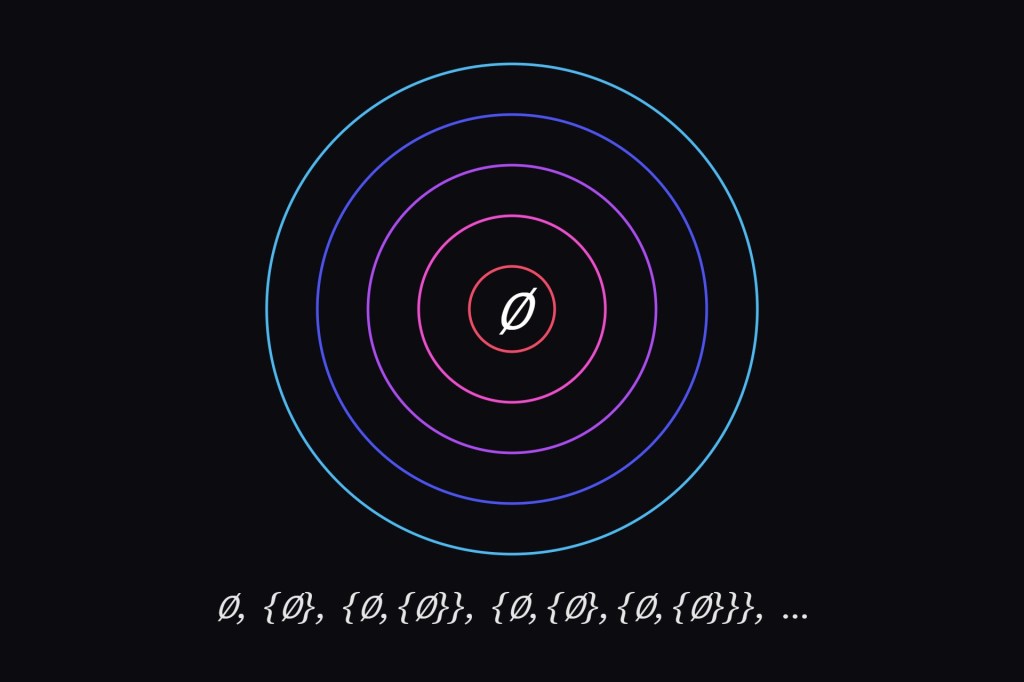
In the von Neumann construction of the natural numbers, the empty set plays the role of 0, and we construct the next natural number from the previous one using . Here denotes the successor of . This gives
so that each natural number is the set of all the natural numbers before it.
Therefore, the set contains zero, but is also closed under the successor operation, so it must contain every natural number.
2.7 Axiom Schema of Replacement
Here, means “there exists exactly one ”. As with Specification, is any formula in set theory notation, with parameters being permitted.
The Axiom Schema of Replacement states that if a rule assigns exactly one object to each element of a set , then the collection of all these objects is also a set. In other words, if we replace every element of a set according to a rule, the result is still a set.
This axiom was the key addition made by Fraenkel (1922) and Skolem (1923) to Zermelo’s original system. For example, starting from the set of natural numbers, , the rule which takes the power set times gives the set
Zermelo’s original axioms cannot prove that this set exists, but the Axiom Schema of Replacement can.
2.8 Axiom of Foundation
This states that every non-empty set contains at least one element which is disjoint from the original set.
The Axiom of Foundation (or Regularity) rules out the existence of a set satisfying , and therefore avoids circular membership: the only element of is itself, and shares the element with , so no element of is disjoint from it.
Alongside the Axiom of Pairing, which guarantees that exists, this axiom also implies that no set is an element of itself.
2.9 Axiom of Choice
Suppose is a set of non-empty sets. The Axiom of Choice states that there exists a function , called a choice function, such that
Hence, the function selects one element from every set in .
Although there may be no defined rule for choosing infinitely many elements from every set, the Axiom of Choice guarantees that such a selection function exists, even though there may not be a method for creating it. Thus, the Axiom of Choice’s importance becomes apparent when one considers infinite sets.
The Axiom of Choice is also the most controversial of the axioms. Kurt Gödel (1938) and Paul Cohen (1963) showed that it can be neither proved nor disproved from the other axioms, and it leads to some surprising results, such as the Banach–Tarski Paradox: a solid ball can be cut into finitely many pieces and reassembled into two balls, each the same size as the original.
3. A Foundation of Mathematics
One argument for Zermelo–Fraenkel Set Theory being a foundation of mathematics is that these principles can be used to construct the natural numbers, integers, rational numbers, and the real numbers by Dedekind cuts or equivalence classes of Cauchy sequences. The Axioms of Set Theory can also be written in first-order logic, meaning that every proof follows precise rules which can be checked step by step.
However, Gödel’s Incompleteness Theorems (1931) show that Zermelo–Fraenkel Set Theory cannot be complete. Like any consistent system of axioms which can be listed by a fixed rule and is strong enough to describe arithmetic, it has statements which it can neither prove nor disprove. A famous example is the Continuum Hypothesis, which states that there is no set whose size lies strictly between that of the natural numbers and that of the real numbers. Gödel (1940) and Cohen (1963) showed that it is independent of ZFC.
4. Conclusion
Despite this, Zermelo–Fraenkel Set Theory, together with the Axiom of Choice, remains the standard foundation on which most of modern mathematics is built. From nine short statements about sets, mathematicians can construct numbers, functions and spaces, and almost every theorem in mathematics can, in principle, be traced back to these axioms.
References
Jech, Thomas. Set Theory: The Third Millennium Edition, Revised and Expanded. Springer Monographs in Mathematics, Springer-Verlag, 2003. https://doi.org/10.1007/3-540-44761-X.
Zermelo, Ernst. “Untersuchungen über die Grundlagen der Mengenlehre I.” Mathematische Annalen, vol. 65, 1908, pp. 261–281. https://eudml.org/doc/158344.


Leave a Reply