By Nur Shah KS MS
1. Introduction
You may have been taught that an electron is a tiny ball, circling the nucleus of an atom like a planet around the Sun, with a position and speed that could be written down at any moment. It is a useful picture, and for many purposes a good enough one. However, on closer inspection, this simple model breaks down. We find that tiny particles such as electrons do not have a single, definite position; instead they are described by a wavefunction, , a function which doesn’t tell us where a particle is, but where we are likely to find it. The equation that governs this wavefunction, proposed by Erwin Schrödinger in 1926, is not actually a single formula but a whole family of equations, with a different version for every physical situation we might wish to describe. In this article, we will cover the simplest form of Schrödinger’s equation,
This is called the time-independent Schrödinger’s equation. We can use this remarkably simple equation to study a particle in a one-dimensional ‘box’.
2. What is the wavefunction?
Before we start delving deeper into how to solve Schrödinger’s equation, we first need to understand what it is we are actually solving for: the wavefunction, . is a function that assigns a number to every position along a line. On its own, the value has no direct physical meaning: it can be positive, negative or even complex! Its usefulness comes from what happens when we square it. The quantity
is called the probability density. If you have studied statistics this will be familiar: it is a curve where the height itself is not a probability, but the area underneath it is.
Basically, tells us how probability is spread along the line, rather than the probability at any single point. Indeed, the chance of finding a particle at one exact position is zero. Instead we look at the probability of an interval. This is where integration comes in. The probability of finding the particle between and is given by
This is known as the Born rule, after the physicist Max Born.
Since the particle must be somewhere, the total probability must equal 1. Hence, wavefunctions must satisfy the normalisation condition
Now that we have a better understanding of what is, the remaining question is how to find it in the first place. That is exactly what Schrödinger’s equation is for, but the equation needs a physical setting before it can give us an answer. So let us build one.
3. Building the box
Imagine a cricket ball rolling back and forth along a gutter that is sealed at both ends. Classically, this is the picture we are borrowing: a particle confined to a straight line between two impenetrable walls, placed at and . We define the potential energy of the system, , to be
Inside the box the particle feels no force at all; outside it would need infinite energy to enter, hence we have trapped the particle in the box. This is called the infinite square well.
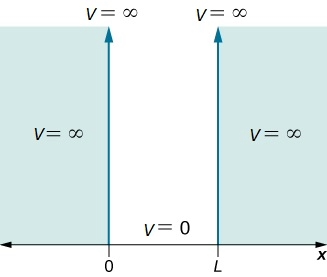
Because the particle can never be outside the box, its probability density must be zero there, so for and . A wavefunction cannot suddenly jump, so it must also be zero at the walls:
These are the boundary conditions, and they follow directly from what we learnt about the wavefunction in the last section. Now we have everything we need to solve Schrödinger’s equation.
4. Solving the equation
Step 1: Finding the general solution
To start with, let us define the terms in equation (1),
is the total energy of the particle and is an operator called the Hamiltonian. An operator is simply an instruction that acts on a function (in this case ) to produce a new function, just as turns into . The Hamiltonian is defined as
Here is the mass of the particle and is the reduced Planck constant, where . The Hamiltonian has two parts, which mirror the two kinds of energy in classical mechanics:
- The first term, , represents the kinetic energy. It involves the second derivative of , which measures how sharply the wavefunction curves.
- The second term, , we have already defined as the potential energy at position .
Putting equation (4) into gives the full equation in the form we will actually solve:
Recall from Section 3 that inside the box, . This simplifies our equation to
Now, we can group the constant terms together and express them as such that
This equation asks for a function that, when differentiated twice, returns a multiple of itself: . Sine and cosine both have this exact property, and the equation is known as the equation of simple harmonic motion. Its general solution is
where A and B are constants.
Step 2: Applying the boundary conditions
At the left wall, gives
since and ,
so the cosine term disappears and we are left with
At the right wall, gives
Either , which would mean the wavefunction is always zero (so there is no particle), or . The sine function is zero only at integer multiples of , so
Step 3: Finding an expression for
Now that we have two equations for k (equation (7) and equation (10)), we can equate them and solve for the total energy, :
Remembering that , we obtain the final expression for energy,
An interesting observation here is that the energy is quantised, meaning it can only take certain discrete values corresponding to different values of . Crucially, it can never be zero. Even in its lowest energy state, a confined particle always retains some kinetic energy. This minimum energy is known as the zero-point energy, . The zero-point energy for an electron in a box is (about ), while a cricket ball in a gutter has of order . While this means the cricket ball is technically moving, the scale is unfathomably small; in billion years (the age of the universe), the ball will have covered a distance of , about the size of a single proton.
Step 4: Normalising the wavefunction
One thing is still missing: the constant . To find it, we can use the normalisation condition outlined in equation (2):
Substituting into equation (9) gives .
Using the identity ,
so we now have
Our complete solution is therefore
5. Conclusion
We have seen that a particle is not a tiny ball with a definite position, but is described by a wavefunction, , whose square gives the probability of finding it. By solving for a particle in a one-dimensional box, we found that the energy is quantised, with , and that the lowest energy is never zero. From a single differential equation and two boundary conditions, we have uncovered one of the strangest and most important ideas in modern science: that for a confined particle, energy comes in discrete steps and is never zero.
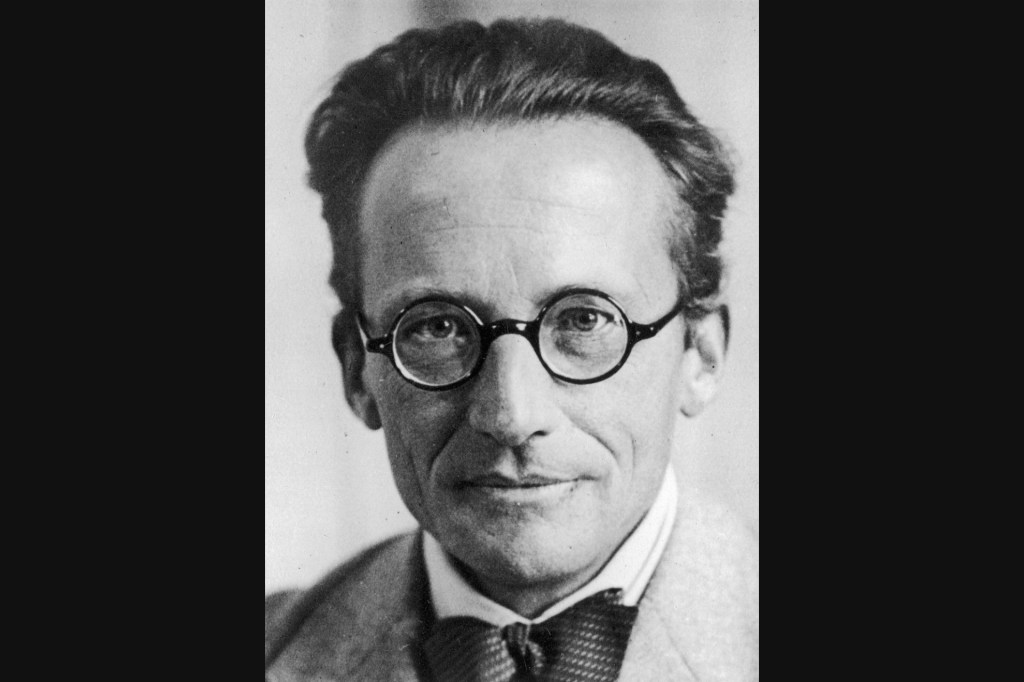
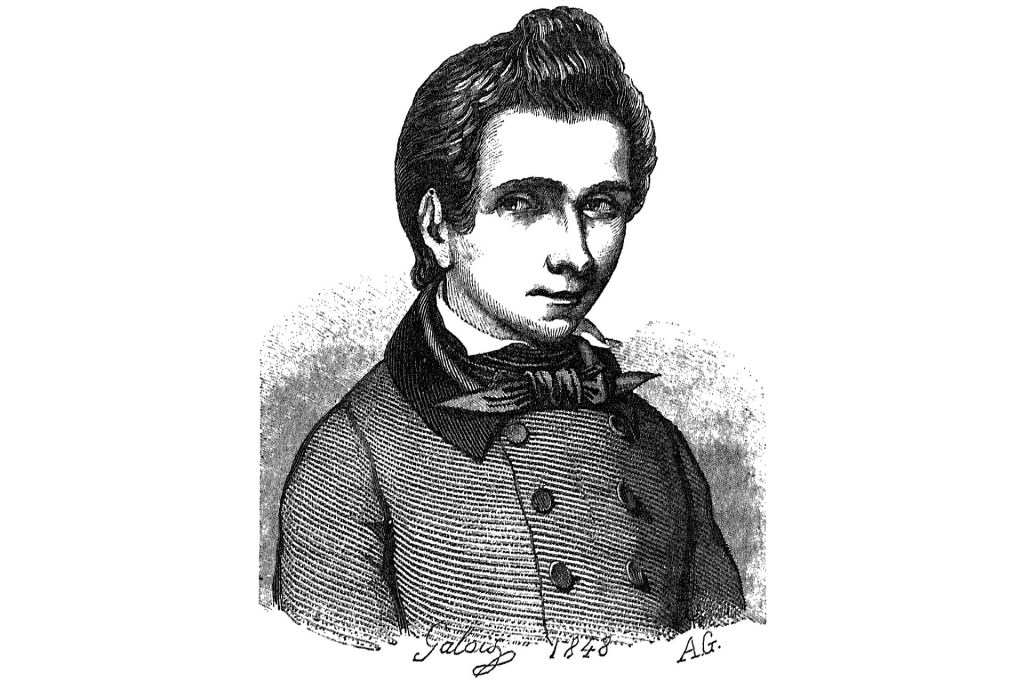
Cover photo: Erwin Schrödinger, public domain, from the National Digital Archives of Poland via Wikimedia Commons.





Leave a Reply