A collection of puzzles to try with a pencil and paper. No calculators needed! They are split into four sections: logic, numbers, geometry and some miscellaneous problems at the end. Have a go at each one, then press the button underneath to reveal the solution.
Got a puzzle for us? Email axiom@etoncollege.org.uk.
Logic
1. Knights and Knaves
On an island, every inhabitant is either a knight or a knave. Knights always tell the truth and knaves always lie. You meet two islanders, A and B.
A says: “We are both knaves.”
B says: “A would say I am a knave.”
What are A and B?
Solution
A is a knave and B is a knight.
Suppose A were a knight. Then A’s statement would be true, so A would be a knave, which is impossible. So A must be a knave.
Suppose B were a knight. Then B’s statement would be true. We know A is a knave and would therefore always lie. Hence, if B were a knight, A would say B is a knave, so B’s statement is true. Our initial assumption was correct and B is a knight.
2. The Fork in the Road
You reach a fork in the road. One path leads to the village and the other leads into a swamp. A guard who knows where both paths go stands at the fork. He either always tells the truth or always lies, but you don’t know which.
You may ask the guard one yes-or-no question. What should you ask to find the way to the village?
Solution
Point at the left path and ask: “If I asked you whether this path leads to the village, would you say yes?” Take the left path if he says yes and the right path if he says no.
If the guard tells the truth, he answers honestly about what he would say, and what he would say is the truth. So “yes” means the left path leads to the village.
If the guard lies, consider both cases. If the left path does lead to the village, he would answer “no” to the direct question, so the honest answer to “would you say yes?” is “no”, and he lies and says “yes”. If the left path leads to the swamp, he would answer “yes” to the direct question, so he lies about that and says “no”.
In every case, “yes” means the left path leads to the village and “no” means the right one does.
3. Three Light Switches
In a basement there are three switches, all currently off. Exactly one of them controls an old-fashioned light bulb in the attic that gets hot while it is on. The other two switches do nothing. You can’t see the attic from the basement. You may flip the switches as often as you like, but you may only go up to the attic once.
How can you work out which switch controls the bulb?
Solution
Turn on switch 1 and leave it on for ten minutes. Then turn switch 1 off, turn switch 2 on, leave switch 3 off, and go straight up to the attic.
If the bulb is on, switch 2 must control it, because switch 2 is the only switch that is on.
If the bulb is off but warm, it was on until a moment ago, so it is controlled by switch 1, the switch that was on for ten minutes and then turned off.
If the bulb is off and cold, it was never turned on, so it must be switch 3.
4. Mislabelled Boxes
There are three boxes. One contains only apples, one contains only oranges, and one contains a mix of both. They are labelled “Apples”, “Oranges” and “Apples and Oranges”, but every label is wrong.
By taking just one piece of fruit from one box, without looking inside, how can you relabel all three boxes correctly?
Solution
Take a fruit from the box labelled “Apples and Oranges”.
Its label is wrong, so this box is not the mixed box. It contains only one kind of fruit, and the fruit you take out tells you which kind.
Suppose you take out an apple. Then this box is the apples box. The other two boxes, labelled “Apples” and “Oranges”, between them contain the oranges and the mix. The box labelled “Oranges” can’t contain only oranges, because its label is wrong, so it must be the mixed box. That leaves the oranges in the box labelled “Apples”, and that label is wrong too, as required.
If you take out an orange instead, the same reasoning with apples and oranges swapped gives: that box is the oranges box, the box labelled “Apples” is the mixed box, and the box labelled “Oranges” contains the apples.
5. The Monty Hall Problem
On a game show there are three closed doors. A car is behind one, chosen at random, and goats are behind the other two. You pick a door. The host knows where the car is, and he always follows the same rules: he opens one of the two doors you didn’t pick, always one with a goat behind it, and then offers you the chance to switch to the other closed door.
Are you more likely to win the car if you switch?
Solution
Yes. If you switch, you win the car with probability 2/3. If you stick, you win with probability 1/3.
Say your first pick is the car, with probability 1/3 of happening. In this case switching loses.
However, say you pick a goat first, which has a 2/3 probability of occuring. Then the car is behind one of the other two doors, and the other one hides a goat. The host must open the door with the goat, because he never reveals the car, so the closed door you can switch to is the car. In this case switching always wins.
So switching wins when your first pick was wrong, which happens with probability 2/3.
Numbers
6. Gauss’s Sum
What is 1 + 2 + 3 + … + 99 + 100?
Solution
5050.
Write the sum forwards and backwards, one above the other: 1 + 2 + … + 100 and 100 + 99 + … + 1. Adding the two rows column by column gives 100 columns, each adding up to 101, so twice the sum is 100 × 101 = 10100. The sum is half of that, 5050. The young Carl Friedrich Gauss is said to have spotted this at school.
7. The Bat and the Ball
A bat and a ball cost £1.10 in total. The bat costs £1.00 more than the ball. How much does the ball cost?
Solution
5p, not 10p!
If the ball costs b, the bat costs b + £1.00, so the total is 2b + £1.00 = £1.10. This gives 2b = 10p, so b = 5p.
Check: the ball costs 5p and the bat costs £1.05. They differ by £1.00 and add up to £1.10. The tempting answer of 10p fails, because then the bat would cost £1.10 and the total would be £1.20.
8. Which Is Bigger?
Without working either number out, decide which is bigger: 2¹⁰⁰ or 3⁶⁰.
Solution
2¹⁰⁰ is bigger.
Write both as 20th powers: 2¹⁰⁰ = (2⁵)²⁰ = 32²⁰ and 3⁶⁰ = (3³)²⁰ = 27²⁰.
For positive numbers, a bigger number raised to the same positive power gives a bigger result. Since 32 > 27, it follows that 32²⁰ > 27²⁰, so 2¹⁰⁰ > 3⁶⁰.
9. The Last Digit
What is the last digit of 7²⁰²⁶?
Solution
9.
The last digit of a product depends only on the last digits of the numbers being multiplied. Since 7⁴ = 2401 ends in 1, every power (7⁴)ᵏ also ends in 1.
Now 2026 = 4 × 506 + 2, so 7²⁰²⁶ = (7⁴)⁵⁰⁶ × 7². The first factor ends in 1 and 7² = 49 ends in 9, so 7²⁰²⁶ ends in 1 × 9 = 9.
10. Remainders
Find the smallest positive whole number that leaves a remainder of 1 when divided by each of 2, 3, 4, 5 and 6, but is exactly divisible by 7.
Solution
301.
If N leaves remainder 1 when divided by each of 2, 3, 4, 5 and 6, then N − 1 is divisible by all of them, so N − 1 is a multiple of their lowest common multiple, 60. Conversely, any such N works. So N is one of 1, 61, 121, 181, 241, 301, …
Checking these in order for divisibility by 7: 1, 61 = 56 + 5, 121 = 119 + 2, 181 = 175 + 6 and 241 = 238 + 3 all fail, but 301 = 7 × 43. So the smallest such number is 301.
11. Trailing Zeros
100! means 100 × 99 × 98 × … × 2 × 1. How many zeros does this enormous number end with?
Solution
24.
The number of zeros at the end is the number of times 10 = 2 × 5 divides 100!. That is the smaller of two counts: how many factors of 2 are in 100!, and how many factors of 5.
Counting the 2s the same way as the 5s below (50 multiples of 2, 25 of 4, 12 of 8, 6 of 16, 3 of 32 and 1 of 64) gives 97 factors of 2. That is far more than the number of 5s, so the 5s decide the answer.
Each of the 20 multiples of 5 up to 100 gives one factor of 5. The 4 multiples of 25 (25, 50, 75 and 100) each give one extra factor, and no number up to 100 is a multiple of 125. That makes 20 + 4 = 24 factors of 5, so 100! ends in exactly 24 zeros.
12. Handshakes
At a party there are 10 people, and every pair of them shakes hands exactly once. How many handshakes take place?
Solution
45.
Each person shakes hands with the 9 others, which gives 10 × 9 = 90. But this counts every handshake twice, once for each of the two people involved. So there are 90 ÷ 2 = 45 handshakes.
Geometry
13. Area of a Triangle
Triangle ABC has a base AB of 10 cm. The angle at C is a right angle, and the height of the triangle, measured from AB up to C, is 6 cm.
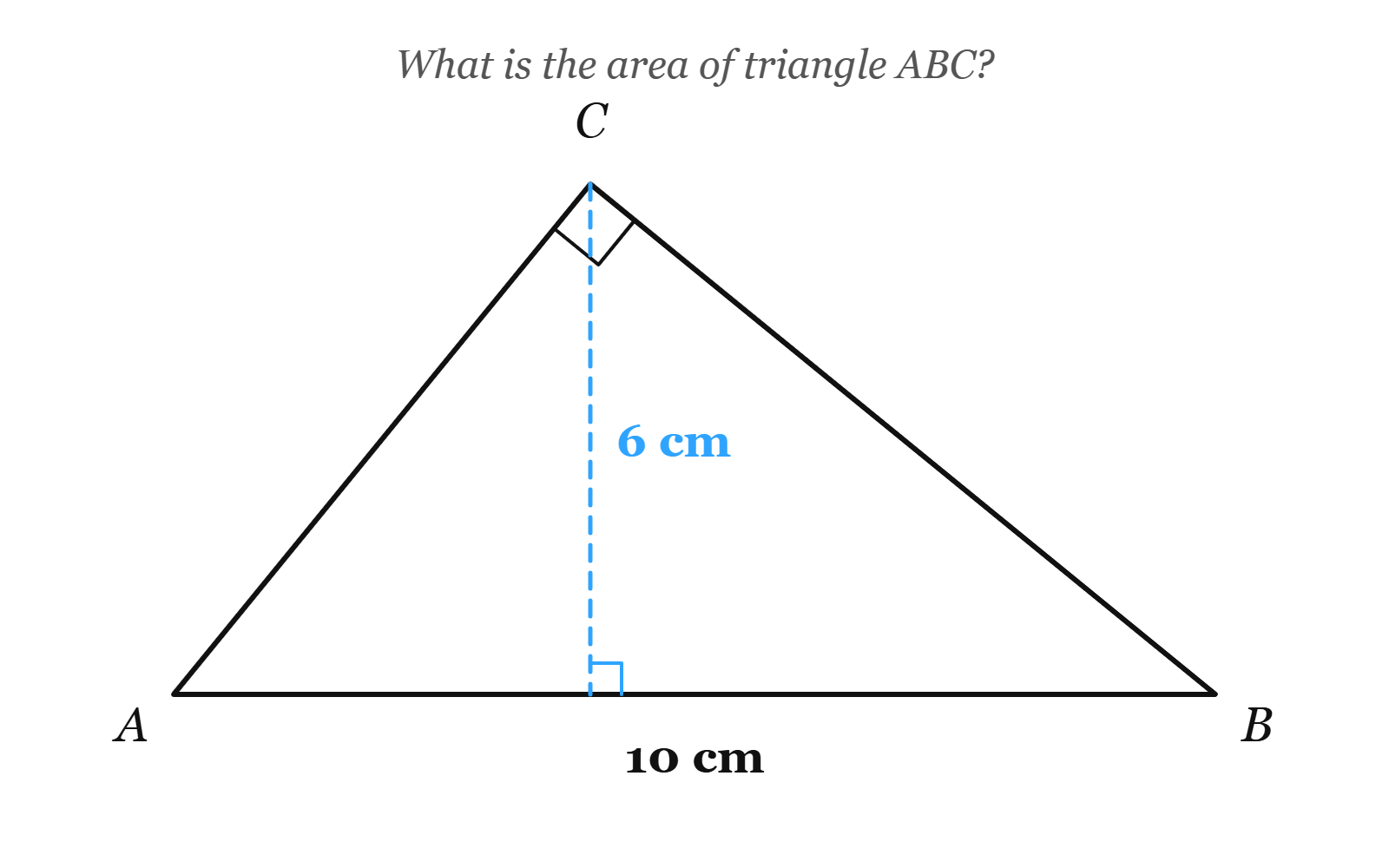
What is the area of the triangle?
Solution
There is no answer, because the triangle cannot exist!
It is tempting to say ½ × 10 × 6 = 30 cm². But look at the right angle.
Let M be the midpoint of AB. In a right-angled triangle, the midpoint of the hypotenuse is the same distance from all three corners. This is Thales’ theorem: C lies on the circle with diameter AB. So MC = MA = 5 cm.
The height of the triangle is the shortest distance from C to the line AB, so it can’t be more than the distance from C to the point M on that line. The height is therefore at most 5 cm, reached only when C is directly above M.
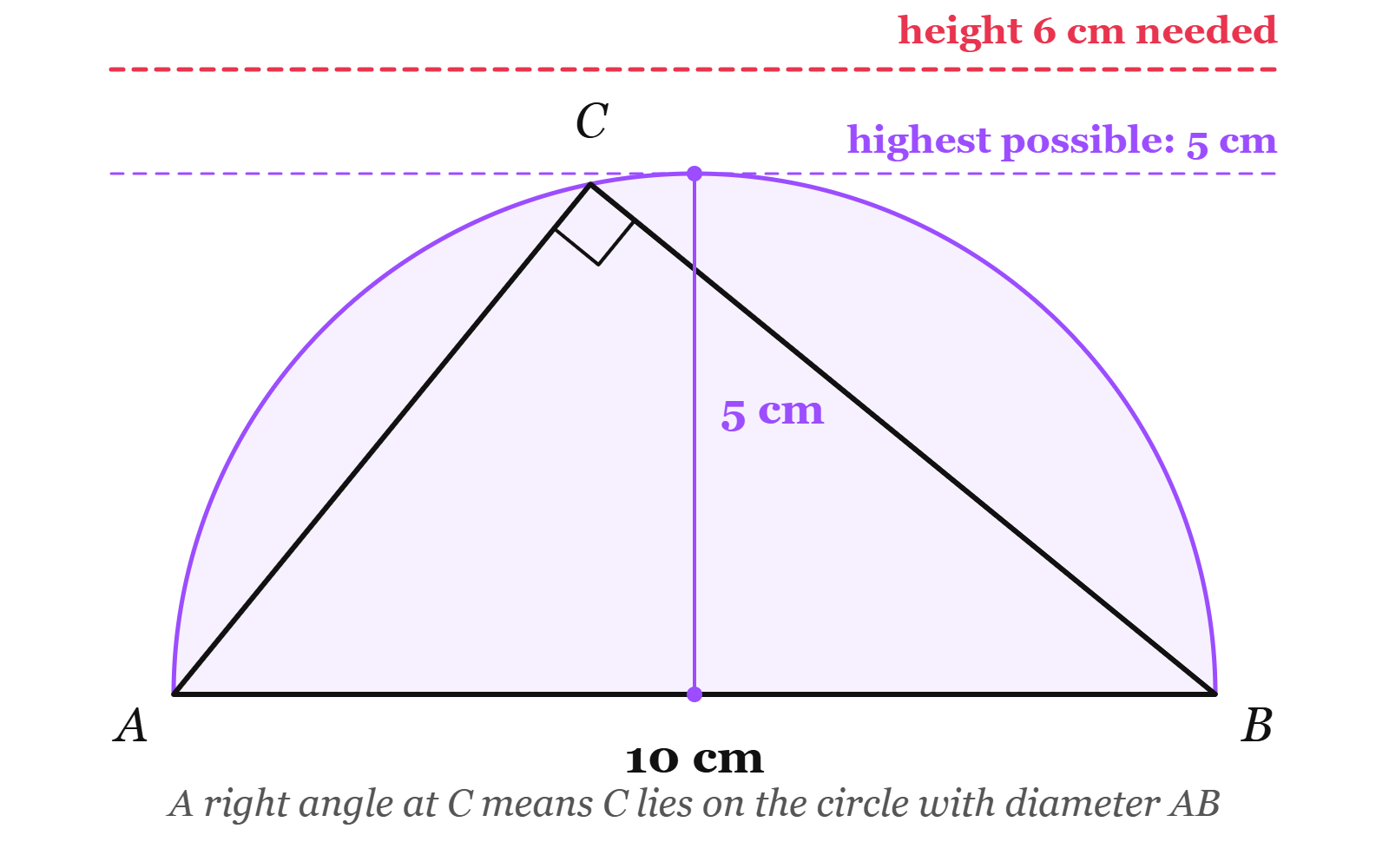
A height of 6 cm is more than 5 cm, so no triangle with these measurements exists. The diagram looks believable, but it can’t be drawn accurately.
14. Square in a Circle in a Square
A circle fits exactly inside a square of side 10 cm, touching all four sides. A smaller square is then drawn inside the circle, with all four of its corners on the circle. What is the area of the smaller square?
Solution
50 cm².
The circle touches opposite sides of the big square, so its diameter is 10 cm.
Each corner of the small square is a right angle on the circle, so by Thales’ theorem the diagonal opposite it is a diameter of the circle. Each diagonal is therefore 10 cm long. If the small square has side s, Pythagoras’ theorem gives s² + s² = 10², so 2s² = 100 and the area is s² = 50 cm². That is exactly half of the big square.
15. The Rope Around the Earth
Imagine the Earth is a perfect sphere, and a rope is tied tightly around the equator, which is about 40,000 km long. The rope is then made 1 metre longer and lifted so that it sits at the same height above the ground all the way round. Roughly how big is the gap? Could a cat crawl underneath?
Solution
About 16 cm, so a cat could squeeze underneath!
If the Earth’s radius is r and the gap is h, the rope’s length goes from 2πr to 2π(r + h). The difference is 2πh, and it must equal 1 m.
So h = 1/(2π) m. With π ≈ 3.14, that is about 1/6.28 m ≈ 0.16 m, or 16 cm.
Surprisingly, r cancels out, so the size of the Earth doesn’t matter at all. The answer would be the same for a rope around a football.
16. Star Angles
A five-pointed star is drawn by joining every second vertex of a regular pentagon. What do the five angles at the points of the star add up to?
Solution
180°.
All five vertices of a regular pentagon lie on a circle, and they divide it into five equal arcs of 360° ÷ 5 = 72°.
At each point of the star, the two lines go to the two vertices that are not next to it. Those two vertices are next to each other, so the angle at the point stands on one 72° arc, the one not containing the point itself.
An angle at the edge of a circle is half the angle at the centre standing on the same arc, so each point of the star is 72° ÷ 2 = 36°. The five points add up to 5 × 36° = 180°.
17. Squares on a Chessboard
Counting squares of every size, from the 64 small squares up to the whole board, how many squares can you find on an 8 × 8 chessboard?
Solution
204.
A k × k square is fixed by the position of its top-left corner. That corner can be in any of the first 9 − k columns and any of the first 9 − k rows, so there are (9 − k)² squares of size k × k.
For k = 1, 2, …, 8 this gives 64, 49, 36, 25, 16, 9, 4 and 1 squares, a total of 204.
Miscellaneous
18. The Clock
What is the angle between the hour hand and the minute hand of a clock at exactly 3:15?
Solution
7.5°.
The numbers on a clock face are 360° ÷ 12 = 30° apart.
At 3:15 the minute hand points exactly at the 3. The hour hand moves steadily from the 3 to the 4 between 3:00 and 4:00, so at 3:15 it is a quarter of the way there. That puts it a quarter of 30° past the 3, so the angle between the hands is 7.5°.
19. The Mutilated Chessboard
Two opposite corner squares are cut off a chessboard, leaving 62 squares. Can the remaining board be covered exactly by 31 dominoes, if each domino covers two squares that share a side?
Solution
No.
Opposite corners of a chessboard are the same colour, so removing them leaves 32 squares of one colour and only 30 of the other.
Two squares that share a side are always different colours, so every domino covers exactly one black square and one white square. Then 31 dominoes would cover exactly 31 squares of each colour. That can’t match 32 and 30, so the covering is impossible.
20. The Snail in the Well
A snail starts at the bottom of a 10 m well at the start of day 1. Each day it climbs up 3 m, and each night it slides back down 2 m. On which day does it reach the top?
Solution
On day 8.
Each full day and night, the snail gains 3 − 2 = 1 m. So it starts day k at a height of k − 1 metres, and the highest it gets during day k is (k − 1) + 3 = k + 2 metres.
It reaches the top on the first day with k + 2 ≥ 10, which is k = 8. On day 7 it only reaches 9 m before sliding back. On day 8 it starts at 7 m, climbs to 10 m and is out before night falls.
21. Weighing Balls
You have 9 balls that look identical. Eight of them weigh the same, and one is slightly heavier. Using a balance scale only twice, how can you find the heavy ball?
Solution
Split the balls into three groups of three, A, B and C, and weigh A against B.
If one side is heavier, the heavy ball is in that group. If they balance, every ball on the scale is a normal one, so the heavy ball is in group C. Either way, you now know a group of three that contains it.
For the second weighing, take two balls from that group and weigh them against each other. If one is heavier, that is the heavy ball. If they balance, the heavy ball is the one you left out.

